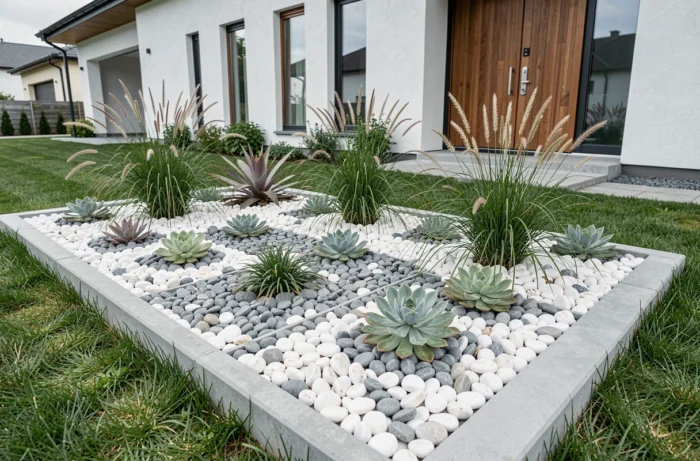
A gravel bed in front of the house, with little or no vegetation, often ends up collecting dead leaves, weed seeds and dust. After a couple of seasons, it no longer looks modern. To create a gravel garden bed that stays attractive over time, treat the stone as a complement to plants, not a substitute for them.
Gravel and living soil: what stones really change beneath the surface
It’s easy to assume that a thick layer of gravel prevents anything from growing and makes a garden bed self-sufficient. Mineral mulch protects the soil from evaporation and limits germination, but it doesn’t eliminate it. Windblown seeds settle on the surface and sprout between the stones, so even a gravel bed needs occasional weeding.
The problem is more pronounced in shady or damp areas. Mineral mulch laid in the shade traps moisture close to the ground, encouraging moss and green algae. Gravel works better in dry, sunny beds, paired with rock-garden or steppe perennials. If your bed faces north or the soil stays waterlogged in spring, a living ground cover is a better choice than pebbles.
Another point that’s rarely mentioned: laying gravel over already dry soil won’t rehydrate it. It’s best to mulch when the soil is moist, after a good rainfall or a thorough watering, so the mineral layer can help retain that moisture for the roots.
Creating a modern, low-maintenance gravel garden bed is therefore about targeting suitable areas rather than covering the entire front of the house with white stones.
Dense planting with gravel as a complement: a combination that lasts
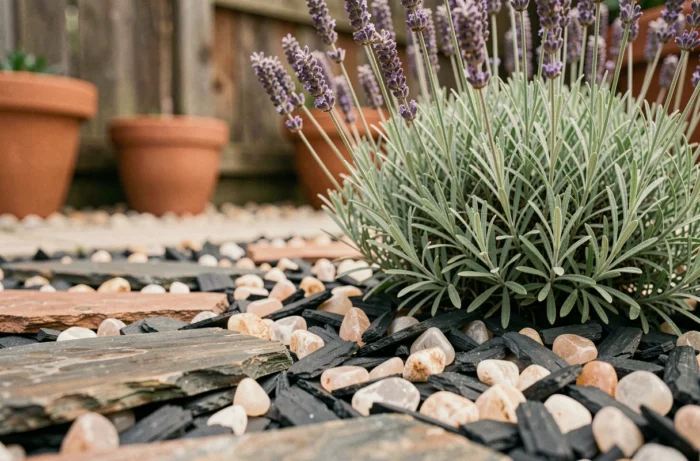
A well-designed mineral garden bed isn’t an almost bare bed of stones. Gravel serves as ground cover between perennials planted close together. Plants remain the main feature, not a secondary decoration. When vegetation covers most of the surface, weeds get less light to germinate, and weeding is reduced to a few sessions a year.
Ground covers that reduce weeding
Ground covers shade the soil, loosen it with their roots and help prevent erosion. They’re a practical alternative to an all-stone design for anyone looking to cut down on maintenance without sacrificing a neat appearance.
- Wild thyme spreads across well-drained soil and tolerates heat. It forms a low-growing carpet that leaves little room for weeds between the stones.
- Blue fescue adds a graphic grey-green accent, tolerates drought and pairs well with light-colored gravel.
- Sedum (stonecrop) quickly fills empty spaces, grows in full sun and needs neither watering nor pruning.
- Dwarf yarrow stays low, flowers for part of the summer and thrives in poor soil.
The aim is to reserve stones for paths, borders and the spaces between clumps, while letting plants cover the rest. The result is a clean, modern-looking bed with living soil beneath the surface.
Choosing and laying gravel: size, depth and edging
The finished look depends as much on the type of stone as on how it’s laid. Gravel that’s too fine shifts underfoot, while oversized pebbles can create an inelegant “dried-up river” effect in front of a contemporary home.
Choosing the right gravel size
A size of 10 to 20 mm offers the best balance for a bed in front of the house: heavy enough to stay in place, yet fine enough to follow the contours of the plants. Crushed gravel (limestone, schist or porphyry) compacts better than rounded pebbles, making the surface more stable.
For a contrasting design, you can combine two sizes: fine gravel between the plants and a few larger stones as visual accents. The key is not to use too many colors. Two shades—one light and one dark—are enough to keep the look crisp.
Depth and soil preparation
Spread the gravel in an even layer. If it’s too thin, the geotextile or soil underneath will show through. If it’s too thick, planting becomes difficult and material costs rise. Aim for an even layer that covers the soil without burying the crowns of the perennials.
Landscape fabric is laid before the gravel, but it has its limitations: it eventually breaks down, roots grow through it, and organic debris forms a layer of topsoil above it. In a densely planted bed, you can skip it if the soil is weed-free and the plants provide enough ground cover.
Edging to keep gravel in place
Without edging, gravel will spread onto the lawn or pavement within a few months. Corten steel, aluminum or natural stone edging defines the bed and creates the clean lines that give it a “modern look.” Sink it into the ground so it’s hidden or sits flush with the surface.
What maintaining a gravel garden bed really involves each season
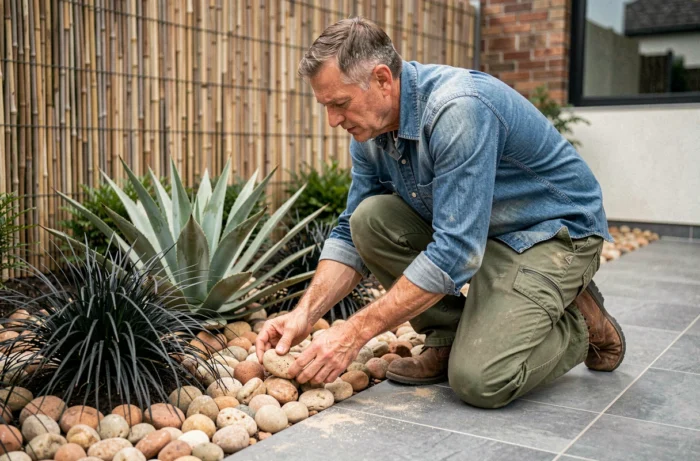
Calling it “maintenance-free” is an exaggeration. “Low-maintenance” is more accurate, provided the ground has been prepared properly.
- In spring, remove dead leaves caught between the pebbles and pull out any weeds that have sprouted on the surface. A quick pass with a leaf blower is enough for larger areas.
- In summer, make sure the perennials get enough water during their first few years. Once established, most can manage on their own thanks to the mineral mulch, which limits evaporation.
- In autumn, cut back faded perennials and top up the gravel where it has become sparse.
- In winter, there’s little or nothing to do. Gravel doesn’t freeze, rot or decompose.
The real savings become clear over several years: no mowing, scarifying or regular fertilizing. Compared with a conventional lawn, a gravel-and-perennial bed takes far less time to maintain, especially during dry spells when watering a lawn becomes a costly chore.
The result depends as much on planting density as on the choice of gravel. A modern gravel garden bed isn’t an empty mineral space; it’s a structured dry garden where every element—stone, plant and edging—has a specific purpose. You save time not by removing plants, but by choosing plants that do the work for you.