
During a real estate sale, the boundary between what stays in the house and what the seller can take is not always clear. The Civil Code distinguishes between movable property and immovables by destination, but this classification, inherited from the Napoleonic era, leaves gray areas that the sales agreement must clarify. Understanding this distinction helps avoid disputes between the seller and the buyer at the time of key handover.
Removal of equipment by the seller: legal risks and buyer’s recourse
The scenario is common: the buyer discovers, during the exit inspection, that a visible item during the visits has disappeared. The fitted kitchen has been dismantled, the wall sconces are missing, or the automated gate has been replaced with a manual model.
The seller has a compliance delivery obligation according to the content of the sales agreement. If an item was listed in the inventory attached to the deed or falls into the category of immovables by destination (Articles 517 and 524 of the Civil Code), its removal constitutes a contractual breach. The buyer can then demand restoration, a price reduction, or damages.
To know precisely what must be left during the sale of a house, it is necessary to distinguish what is fixed to the building from what can be moved without damage. A chandelier hung on a hook remains movable property. A built-in extractor hood becomes an immovable by destination.
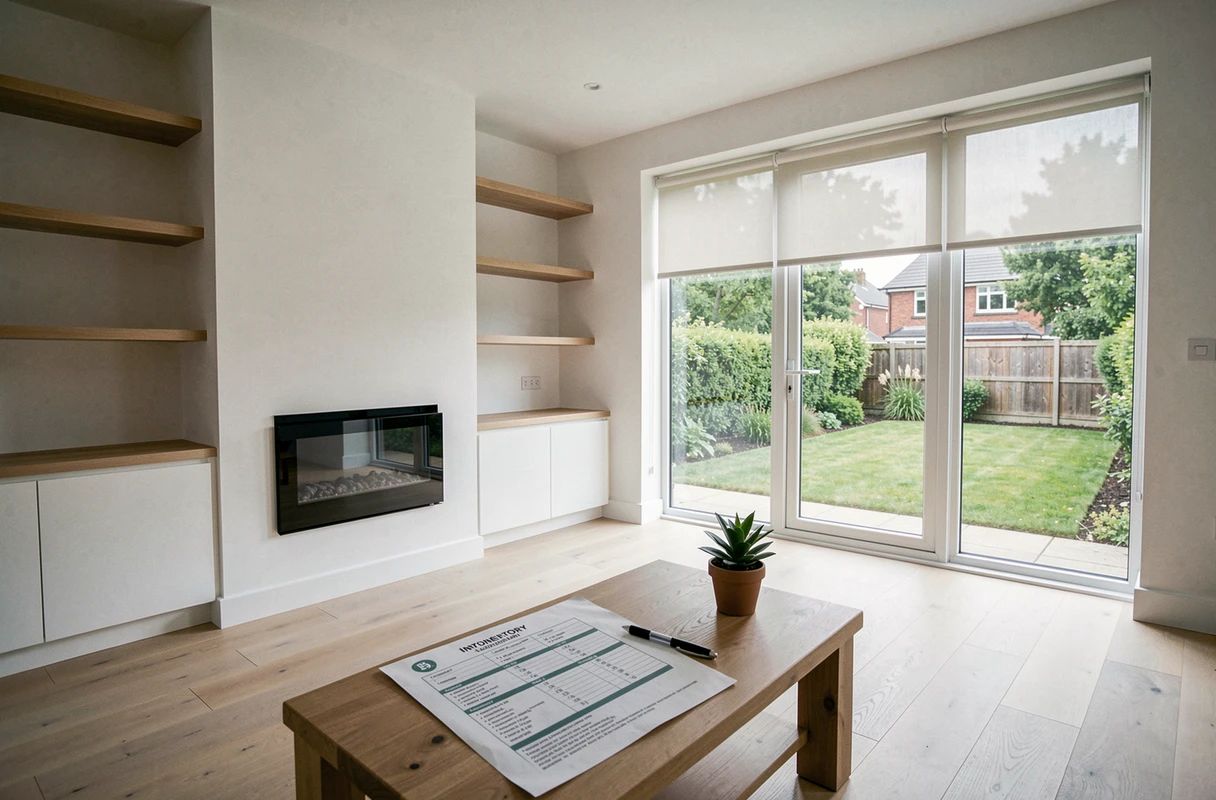
The most reliable solution remains the contradictory inventory attached to the sales agreement. This document lists each item that the seller commits to leaving, along with its estimated value. Without this inventory, it is case law that decides, often on a case-by-case basis.
Immovables by destination and movable property: comparative table
The confusion between movable property and immovables by destination generates the majority of post-sale disputes. The table below classifies the most common equipment according to their usual legal qualification.
| Equipment | Common Qualification | Can the seller take it? |
|---|---|---|
| Fireplace, insert | Immovable by destination | No |
| Boiler, sealed radiators | Immovable by destination | No |
| Fitted kitchen (fixed cabinets, countertop) | Immovable by destination | No |
| Sink, faucets | Immovable by destination | No |
| Parquet, moldings | Immovable by destination | No |
| Custom wardrobe (fixed to the walls) | Immovable by destination | No |
| Automated gate, built-in alarm | Immovable by destination | No |
| Solar panels (owned) | Immovable by destination | No |
| Chandelier, ceiling light on hook | Movable | Yes |
| Curtains, non-sealed rods | Movable | Yes |
| Freestanding appliances (washing machine, refrigerator) | Movable | Yes |
| Unfixed storage furniture | Movable | Yes |
The determining criterion is the method of attachment to the building. Equipment that is sealed, screwed, or built into the structure of the dwelling is presumed to be immovable by destination. An object that is simply placed or hung on a removable support remains movable property.
Solar panels and security equipment: specific cases to anticipate
Some recent equipment does not appear in classic lists but raises specific questions during the sale.
Solar panels: ownership or rental
When the photovoltaic panels belong to the seller, they are considered immovables by destination and remain with the property. However, if the panels are subject to a rental agreement, this contract is transferred to the buyer with the sale. The seller must disclose this situation in the sales agreement to avoid any surprises regarding the remaining monthly payments.
Wired security equipment
Wired surveillance cameras, integrated alarm systems, and motorized gates fall into the category of permanent installations. Their removal would leave holes, cut cables, or empty boxes, which would affect the property’s compliance.
- A wired alarm connected to the electrical panel remains in the house, unlike a standalone wireless unit that the seller can take.
- A video intercom built into the wall is an immovable by destination, while a wireless intercom placed on furniture remains movable property.
- The motorization of roller shutters, integrated into the shutter box, cannot be removed without damaging the installation.

Sales agreement: how to draft the inventory to avoid disputes
The sales agreement is the only document that resolves ambiguous situations. Without an attached list, each party interprets the sale according to their own expectations.
The inventory should function as a contractual snapshot of the property. It lists the items the seller leaves, specifies their condition, and, if applicable, their declared value to distinguish them from the price of the real estate. This distinction has a tax interest: the movable property listed separately is not subject to the same transfer duties as the real estate itself.
Three points deserve particular attention when drafting:
- List each room in the property and its fixed equipment (kitchen, bathroom, laundry room, garage) to avoid forgetting anything.
- Specify exclusions: if the seller wishes to take a light fixture, a rod, or a custom piece of furniture, they must explicitly mention it before signing the sales agreement.
- Attach dated photos to the inventory. In case of dispute, they serve as proof of the condition and presence of the equipment at the time of the agreement.
The list of movable property and equipment can be attached to the sales agreement alongside technical diagnostics and work documents. This annex has the same contractual value as the body of the deed.
A property sold without a detailed inventory leaves the door open for claims. The seller who removes an item not excluded is exposed to a formal notice, or even legal action for non-compliance with delivery. It is better to spend thirty minutes drafting a comprehensive list than several months managing a dispute.