
During an after-school workshop or a rainy afternoon at home, you often end up with a folded paper fortune teller, ready to use, but with the empty space under the flaps. The folding takes two minutes, but the content requires more thought. Here are ten concrete ideas for what to write in a paper fortune teller, transforming this simple origami into a playful mini-oracle that mixes humor, micro-wellness challenges, and introspective questions.
1. Micro-breathing challenges and quick centering

The paper fortune teller is increasingly used in emotion management workshops for children. The principle: write a small regulation ritual under each flap, such as “3 slow breaths with your eyes closed” or “stretch your body like a cat for ten seconds.”
This format works well in the morning before school or after a hectic day. The fortune teller becomes a tool for kind coaching accessible from age 5, without any materials or apps. You pull a flap, perform the action, and calm returns faster than with a simple “calm down.”
If you’re looking for more ideas on what to write in a paper fortune teller, the variations around wellness offer fertile ground that goes beyond just a game.
2. Ultra-simple introspective questions for family meals

Placing a fortune teller in the middle of the table breaks the routine of “how was school?”. You write short questions that invite real answers: “What moment made you proud today?”, “If you could redo your day, what would you change?”, “Describe your mood with an animal name.”
This type of content is suitable for both children and adults. Feedback varies on this point, but we observe that open-ended and quirky questions trigger more sincere conversations than standard school questions.
3. Absurd challenges and quirky mimes for birthdays

In a party context, the challenge fortune teller remains a classic, but we benefit from moving beyond “do ten push-ups.” We prefer absurd instructions: “Mime a penguin doing grocery shopping,” “Tell a joke while whispering,” “Talk like a robot for a minute.”
The absurd works better than pure physical challenges for keeping the attention of a mixed group (shy and outgoing children together). This way, we avoid making some feel excluded by a challenge that’s too athletic.
4. Personalized compliments to distribute in class
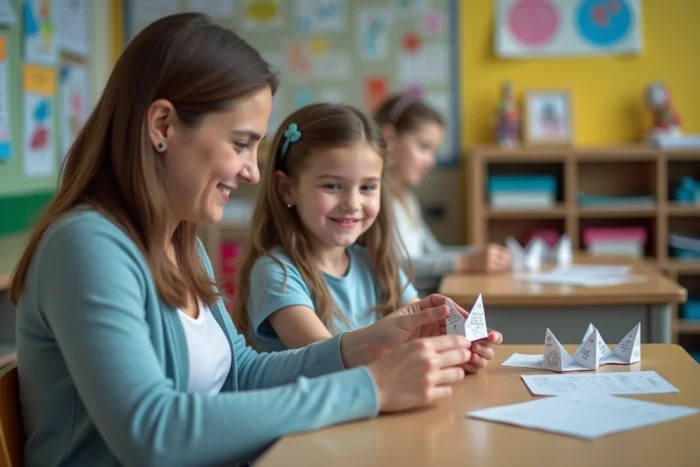
Rather than generic messages, we write targeted compliments: “You explain math really well to others,” “Your way of drawing trees is unique.” The teacher or facilitator prepares the fortune tellers in advance with real observations about each child.
This format has a concrete effect on group dynamics. Receiving a specific compliment through a game de-dramatizes the moment and boosts confidence without going through a formal speech.
5. Daily mini-oracle with wacky predictions

We draw inspiration from the English fortune teller to write quirky predictions: “You will find a lonely sock before tonight,” “Someone will offer you a cake this week,” “A cat will look at you strangely tomorrow.”
The humorous tone is key. We avoid vague predictions like horoscopes (“you will experience a big change”) in favor of concrete and verifiable micro-predictions, which encourages pulling out the fortune teller the next day to check.
6. Creative challenges in a limited time for DIY workshops
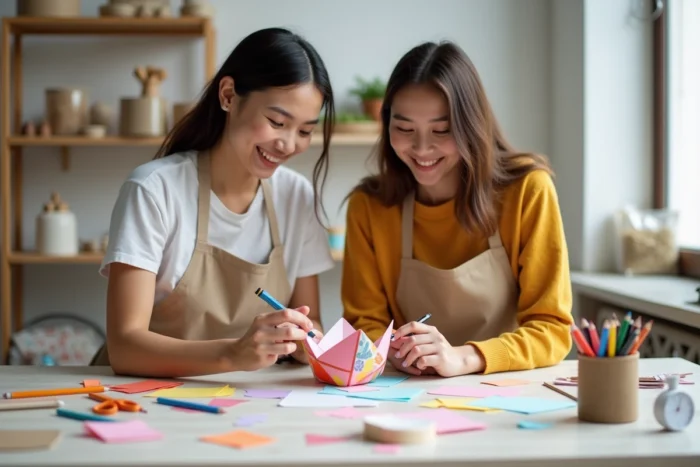
We write short artistic instructions: “Draw a monster in less than thirty seconds,” “Invent an animal that doesn’t exist and give it a name,” “Write a two-line poem about the rain.”
This content transforms the fortune teller into an idea generator for creative workshops. Each draw restarts the activity without the facilitator needing to come up with a new instruction each round.
7. Seasonal fortune tellers with messages tailored to holidays
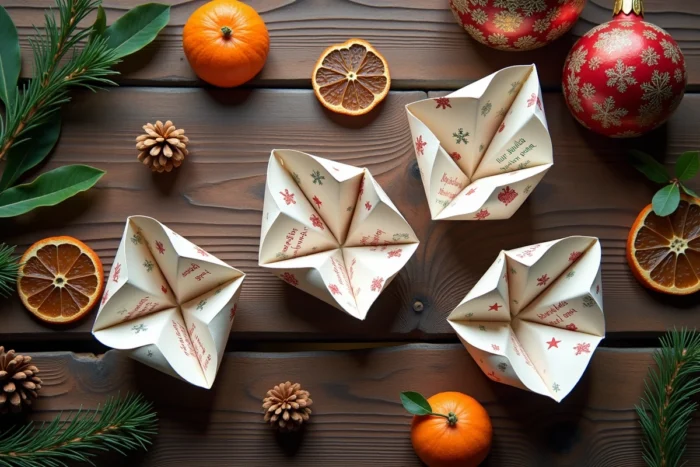
Leisure center facilitators use themed fortune tellers related to the seasons: at Halloween, “invent the funniest spell”; at Christmas, “mime a tired reindeer”; in summer, “share your best vacation memory.”
The advantage of this approach: we recycle the same format throughout the year by only changing the content. One well-folded fortune teller is enough; we replace the messages each season. Here are some themes that work well:
- Halloween: invented spells, creature imitations, scary stories in one sentence
- Christmas: wishes for the year, singing challenges to hum, riddles about traditions
- Summer: vacation memories, outdoor challenges, descriptions of imaginary ice creams
8. Words of love and little attentions for a wedding

As wedding table decoration, the paper fortune teller replaces the static guestbook. We write questions for the guests: “Your best memory with the newlyweds?”, “One piece of marital advice in one sentence,” “Describe this couple in three words.”
The interactive format generates more spontaneous responses than a notebook placed in a corner. Guests play, exchange between tables, and the newlyweds receive messages they would never have obtained otherwise.
9. Portable jar of positive ideas

The concept of a jar of positive words translates very well into a fortune teller. We write affirmations grounded in reality: “You have the right to say no today,” “Think of a memory that makes you smile,” “Call someone you haven’t seen in a long time.”
Compared to the jar, the fortune teller has a practical advantage: it fits into a bag, backpack, or pocket. You pull out a message each morning like a portable daily kind coaching ritual.
10. Seeded paper fortune teller for a message that can be planted
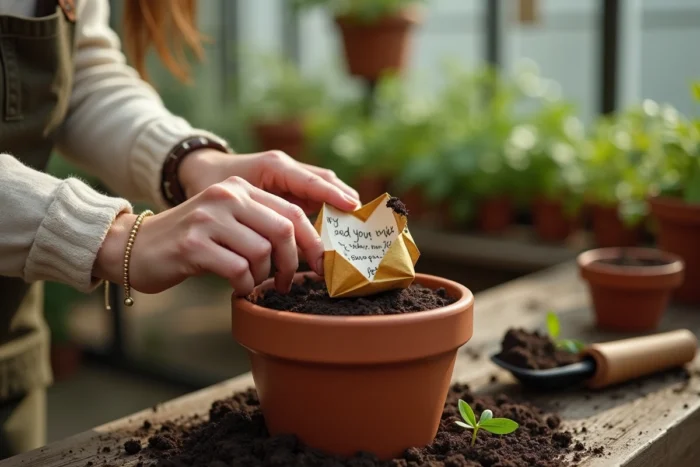
Some creative workshops offer to make fortune tellers from seeded paper. You read the message, then plant the paper in a pot. The seeds sprout in a few days.
This format combines play, positive messaging, and ecological awareness. We write phrases related to growth: “Like this seed, grow at your own pace,” “Water this paper and see what grows.” The message doesn’t disappear; it transforms into a plant, giving a concrete dimension to the activity.
The paper fortune teller remains one of the few game supports that requires no batteries, no connection, and no budget. Whether the content is funny, introspective, or poetic, it’s the text under the flaps that makes all the difference. A square sheet, a good fold, and messages tailored to the context are enough to transform a basic origami into a tool that children (and adults) pull out themselves.