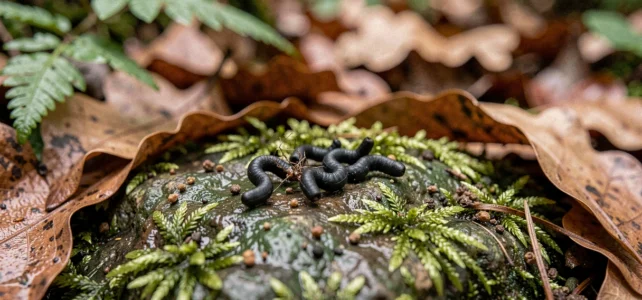
Amphibian droppings remain a blind spot in amateur naturalism. Their small size and rapid degradation on the ground partly explain this lack, but their analysis provides concrete clues about the state of invertebrate fauna and the quality of a forest environment.
Composition of salamander droppings: what a careful examination reveals
The droppings of the spotted salamander (Salamandra salamandra) appear as small dark cylinders, often black or dark brown, deposited on the moist forest litter. Their length rarely exceeds that of an elongated grain of rice.
Their consistency varies depending on the recent diet of the animal. A dropping rich in insect shell fragments appears grainy, while a diet dominated by earthworms or slugs produces a smoother and softer dropping. This difference in texture is the first observable clue.
When observed under a magnifying glass, one can sometimes distinguish chitinous remains (beetle legs, elytra, millipede mandibles). These fragments allow for a partial inventory of the surrounding soil microfauna. When attempting to identify salamander droppings, it is precisely this reading of food remains that transforms a simple dropping into an ecological data point.
The available data do not allow for a reliable identification key as is possible for mammals. The small size of the feces, their resemblance to those of other small amphibians or certain invertebrates (slugs, large beetles) complicates field determination without additional context.
Where and when to look for salamander droppings in the forest
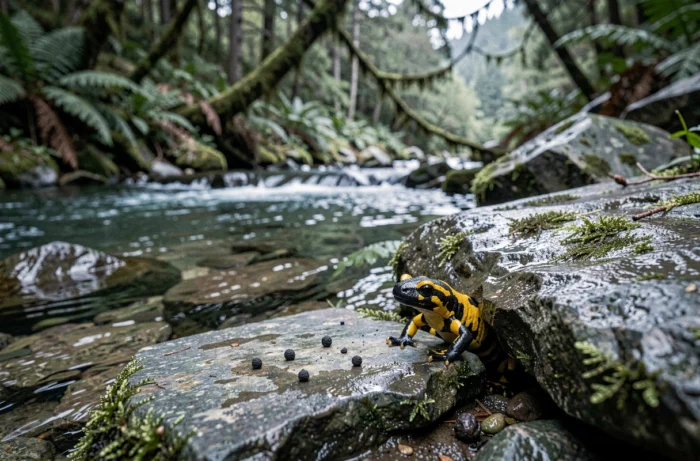
The spotted salamander frequents deciduous and mixed forests, humid hedgerow areas, and the vicinity of springs or small streams. Searching for its droppings in dry or very sun-exposed environments is futile.
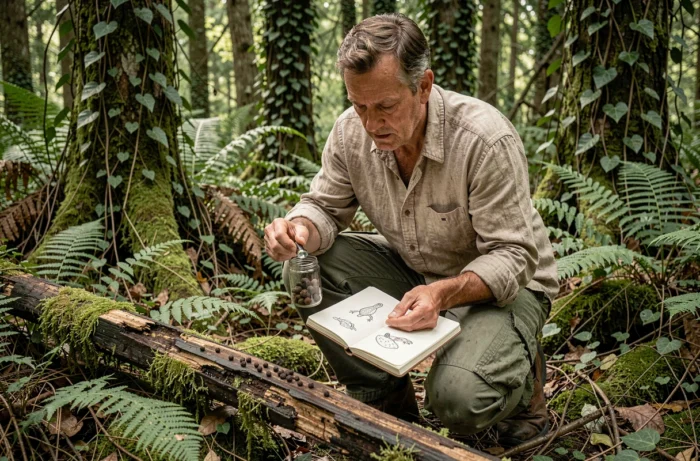
Rainy nights in spring and autumn constitute the main activity windows for the species. Adults come out to hunt on the litter, and it is early in the morning, after a humid night, that the chances of spotting fresh feces are highest.
Micro-habitats to prioritize
- Under flat stones and decaying dead wood in shaded areas, where salamanders take refuge during the day.
- Earthen banks of forest streams and the vicinity of springs, particularly north-facing slopes with clay soil.
- Dry stone walls at the edge of woods and banks of sunken paths, especially in hedgerow regions (Brittany, Normandy, Central Massif).
The soil must be sufficiently moist so that the droppings do not dry out within a few hours. On overly draining substrates (sand, gravel), the droppings disintegrate before any observation. A forest soil with thick litter retains clues for several days.
Spotted salamander and soil biodiversity: a direct link
The regular presence of salamander droppings at a site indicates a functional food chain. The animal feeds on worms, woodlice, small beetles, spiders, and various larvae. An environment that hosts active salamanders necessarily harbors a diverse soil fauna.
Conversely, a prolonged absence of traces (droppings, observed individuals, larvae in water bodies) may signal environmental degradation. The regression of hedgerows and aquatic habitats, combined with pollution, is among the pressures identified in the assessment of the IUCN Red List of reptiles and amphibians in France. This document reports declines in spotted salamander populations already observed in Brittany and Normandy.
The fragmentation of natural habitats and the impacts of climate change exacerbate this trend. Wooded corridors and hedges play a linking role between populations. When these corridors disappear, salamanders become isolated, and local genetic diversity erodes.
Common confusions and limitations of field identification
Several sources of confusion complicate the recognition of salamander droppings in the field.
Resembling droppings
Feces from frogs and toads, particularly those of the common toad (Bufo bufo), share a similar size and color. Field reports vary on this point: some naturalists rely on shape (more cylindrical in salamanders, more irregular in anurans), while others deem the distinction impossible without laboratory analysis.
The droppings of large black slugs (Arion ater) also produce dark cords on the litter, often confused with amphibian droppings. The presence of residual mucus around the slug dropping is a distinguishing criterion, but it quickly disappears in rainy weather.
What enhances determination reliability
- Cross-referencing the presence of droppings with direct observation of adult individuals or larvae in a nearby water body.
- Examining food remains under a binocular microscope: chitin fragments indicate a typical salamander diet.
- Considering the station context (altitude, type of forest, presence of springs), as the spotted salamander is absent from dry Mediterranean environments and open agricultural plains.
Caution is advised. An isolated dropping is never sufficient to confirm the presence of a species. Repeated observations over several humid nights, ideally combined with nocturnal surveys using a flashlight, provide a stronger set of clues.
Simple protocol to contribute to local monitoring
Recording observations of salamander droppings, even approximate ones, feeds regional naturalist databases. The protocol does not require expensive equipment: a camera with a macro function, a small ruler for scale, and a field notebook are sufficient.
Note the date, time, weather conditions of the last hours, the nature of the substrate, and the GPS location of the observation point. Photograph the dropping with the ruler next to it. This data, sent to local herpetological associations, contributes to population monitoring.
The IUCN France assessment highlights that the spotted salamander remains common at the national level, but its trend is declining. Citizen monitoring serves as a complement to scientific inventories, provided that observations are dated, geolocated, and documented with photos.