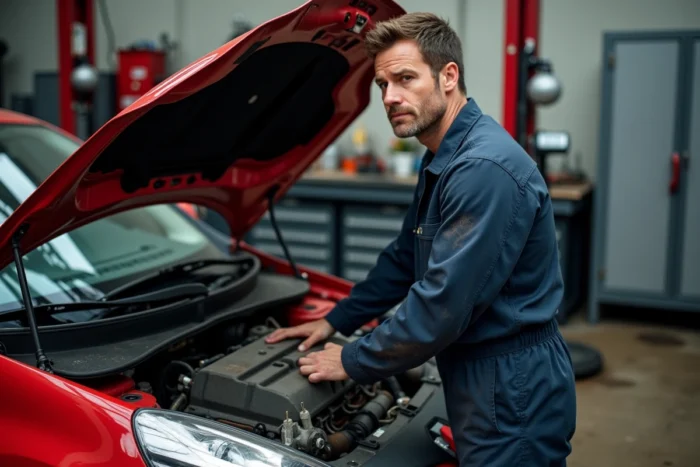
The message “engine failure risk” on the dashboard of a Clio 4 triggers an immediate reaction in most drivers, often disproportionate to the actual cause. Behind this alarming title lies a range of failures, from a simple faulty sensor to critical overheating. Understanding what the ECU is really signaling and knowing how to behave in the minutes that follow makes the difference between a controlled incident and an engine replacement bill.
Timing Chain and Lubrication on Clio 4 TCe Engines
The 0.9 TCe and 1.2 TCe engines mounted on the Clio 4 share a timing chain architecture. This chain, unlike a belt, is not replaced at fixed intervals. It gradually elongates due to wear and the quality of lubrication.
Excessive elongation of the chain alters the timing. The ECU then detects a misalignment between the camshafts and the crankshaft, triggering the message “engine failure risk.” The problem is not always the chain itself: the hydraulic tensioner, fed by oil pressure, can lose effectiveness if the oil level or viscosity is insufficient.
We observe that cases of actual engine failure remain rare on these blocks, but alerts related to the timing system are frequent beyond the halfway point of the engine’s lifespan. The choice of oil and strict adherence to oil change intervals directly condition the longevity of the chain tensioner. Using oil of inappropriate viscosity (for example, a 5W-30 instead of the recommended 0W-30, or vice versa depending on the engine) accelerates wear on the internal lubrication circuit.
When you analyze the engine failure risk on Clio 4, the first check is always on the oil level and the date of the last oil change.

OBD Diagnosis and Common Fault Codes on Clio 4
The message displayed on the dashboard does not provide any indication of the actual severity of the problem. Only reading the fault codes via an OBD port allows for sorting between a critical alert and a false positive.
Several scenarios frequently recur on Clio 4s:
- A code related to the camshaft or crankshaft position sensor, often caused by a corroded connector or a sensor at the end of its life, with no immediate mechanical danger.
- A misfire code on one or more cylinders, which may indicate a faulty coil, a worn spark plug, or a clogged injector.
- A code for insufficient oil pressure or coolant temperature out of range, which requires an immediate stop of the vehicle.
On the 1.5 dCi versions, the message also appears during severe clogging of the EGR valve or a turbo problem. The ECU then enters limp mode, limiting RPM and power to protect the engine.
Disconnecting the battery to clear the message without reading the codes is a mistake. This action, often recommended on forums, erases the stored fault data. The mechanic then loses the history of the fault, complicating and increasing the cost of diagnosis.
Interpretation of the Associated Engine Light
An orange engine light accompanied by the message “engine failure risk” generally indicates an emissions fault or a sensor out of tolerance. The vehicle can drive at moderate speed to a workshop.
A flashing red engine light requires an immediate stop. This signal indicates a severe misfire that could damage the catalyst or cause local overheating of the engine.
Targeted Prevention According to Clio 4 Engine Type
The three main engines of the Clio 4 (0.9 TCe, 1.2 TCe, 1.5 dCi) do not exhibit the same weaknesses. Tailoring maintenance to the specific engine type significantly reduces risks.
0.9 TCe Engine
This three-cylinder turbo mainly suffers from ignition coil and valve cover gasket issues. A preventive replacement of the coils at high mileage avoids most misfire alerts. Monitoring for any signs of oil around the valve cover allows for detecting a leak before it causes a critical drop in level.
1.5 dCi Engine
The Renault diesel remains generally robust, but clogging of the EGR circuit and the particulate filter generates abnormal temperature rises. Regular cleaning of the EGR valve (or its replacement if clogging is advanced) and sufficiently long trips to allow for DPF regeneration are the two most effective prevention strategies.
1.6 RS Engine
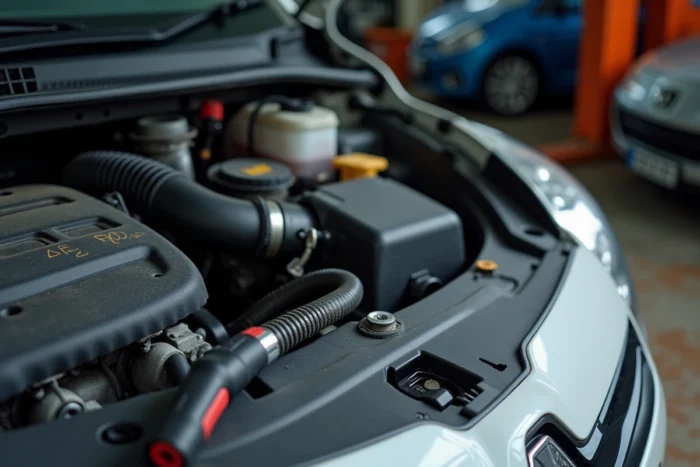
The sport version, which is more thermally stressed, requires particular attention to the cooling system and oil quality. Repeated temperature rises during track use or sporty driving accelerate the degradation of seals and hoses. A visual inspection of the cooling system at each service is recommended.
Actions to Take in the First Minutes After the Alert
The driver’s behavior in the moments following the display of the message often determines the mechanical outcome. We recommend a precise sequence:
- Immediately reduce engine RPM and speed, without abruptly cutting the ignition if the vehicle is in motion.
- Park safely, turn off the engine, and wait a few minutes before opening the hood to visually check the oil level and the condition of the cooling system.
- Do not restart if abnormal smoke, a burnt smell, or a visible leak is observed. Have the vehicle towed.
- If no external signs of severity appear, restart cautiously and drive slowly to a workshop for an OBD diagnosis.
Forcing a long trip with the message displayed turns a repairable problem into an engine failure. The ECU’s limp mode protects the engine, but its limits are quickly reached if the underlying cause is a loss of oil pressure or overheating.
The technical developments made by Renault on the subsequent generations of TCe (simplification of the architecture, removal of the balance shaft, better thermal management) confirm that the weaknesses of the engines mounted on Clio 4 were identified by the manufacturer. Rigorous maintenance, tailored to the exact engine type of the vehicle, remains the best defense against an alert that could be more than just a simple message on the dashboard screen.