
A vape device constantly communicates with its user. Light indicators, rapid blinking, error messages on the screen, or total lack of response: each signal corresponds to a specific state of the device. The problem is that the meaning of a blink or a code varies from one manufacturer to another, and sometimes from one model to another within the same brand. Without the original manual, a cautious reading method must be adopted to avoid worsening a malfunction or damaging the battery.
Blinking light on a vape device: what it does not universally mean
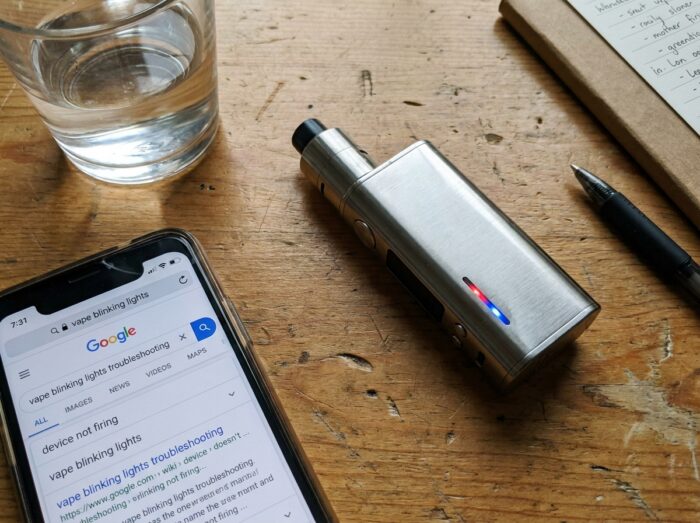
Three rapid blinks, five slow ones, a steady red light: each configuration has a meaning, but it entirely depends on the chipset integrated into the hardware. The same blink can indicate a low battery on one kit and a resistance issue on another.
This is the first mistake to avoid. Searching a forum for the meaning of a light based on a different model than one’s own often leads to a misdiagnosis. If the device is a pod or a simple kit without a screen, the LED light remains the only channel of communication.
On mod boxes equipped with a screen, the displayed message (“atomizer not found,” “short circuit,” “low battery”) is more explicit, but it assumes an understanding of the technical English used by most manufacturers.
A useful reflex before any manipulation: note the exact number of blinks, their color, and their rhythm, then search for the manual of the specific model on the manufacturer’s website. Most brands publish their manuals in downloadable PDF format. When using a disposable puff, the blinking at the end of life generally signals the depletion of liquid or battery, but again, the number of flashes and their meaning vary by manufacturer.

Vape device signals related to resistance and clearomizer
Some alerts concern the connection between the resistance and the rest of the device. When the mod or pod does not detect the resistance, it refuses to operate. On a screen, the message “no atomizer” or “atomizer not found” appears. Without a screen, the light blinks according to a pattern specific to the model.
Check the resistance before blaming the electronics
Before concluding that the mod is faulty, one should unscrew the clearomizer, check that the resistance is properly screwed into its base, and that the connection pin (the metal contact between the clearomizer and the battery) is not pushed in or dirty. A simple cleaning of the threads with a dry cloth is usually enough to restore contact.
If the message persists after re-screwing the resistance, replacing it is the next logical step. A worn resistance or one with a broken resistance wire no longer transmits a signal to the chipset. Field reports vary on the average lifespan of a resistance: it depends on the frequency of use, the type of liquid (very sweet e-liquids clog the coil more quickly), and the wattage applied.
Short circuit: the signal not to ignore
The message “short” or “short circuit” is the most serious in this category. It means that current is flowing through an unintended path, often due to a faulty resistance or a poorly assembled clearomizer. Most modern chipsets automatically cut off power, but continuing to press the fire button despite the alert can damage the protection circuit.
The course of action is simple: immediately remove the clearomizer, visually inspect the resistance and the connection pin, and only reassemble everything after identifying the source of the short circuit.
Battery and alert signals: distinguishing normal wear from failure
The battery remains the most stressed component and the one that generates the most signals. Two situations frequently arise: low battery and overheating.
- Low battery: the light turns red or blinks several times when the charge level drops below a threshold defined by the manufacturer. The vape device can still produce vapor, but the power decreases and the flavors deteriorate. Plugging in the charging cable provided with the kit (not a third-party cable of higher power) remains the only appropriate response.
- Overheating: some chipsets display “too hot” or cut off power after a series of close puffs. This protection signal requires waiting for the device to cool down before resuming use. Forcing operation by removing and reinserting the battery (on a mod with removable batteries) bypasses the safety and exposes one to real risk.
- Damaged removable batteries: on mod boxes that use separate batteries, a torn or peeling insulating wrap is a visual signal to take seriously. A battery with a damaged wrap can cause a short circuit when in contact with the metal tube of the mod. Replacing the wrap or the entire battery is then the only safe option.
When a vape signal requires stopping the use of the device
Not all signals are equal. Some indicate a simple need for recharging or replacing the resistance. Others require immediate cessation of use.
The signals that justify an immediate stop are those concerning electrical safety: repeated short circuits despite a resistance change, persistent overheating after a resting period, visible swelling of the battery or cell, burning smell coming from the mod (and not from the coil). In these cases, the device must no longer be powered, even for “testing.”
In contrast, a low battery light, a “check atomizer” message that disappears after tightening, or a burnt taste related to an empty tank fall under routine maintenance. The altered taste of the liquid often results from a clogged coil or a wattage setting that is poorly calibrated compared to the range indicated on the resistance.
A simple reading grid to remember
- One-time signal that disappears after a simple action (recharge, tightening, resistance change): normal maintenance, no particular risk.
- Recurring signal despite checks: the problem likely comes from the chipset or internal connectivity. Have the equipment examined by a specialized vendor.
- Signal accompanied by an abnormal physical phenomenon (excessive heat, swelling, chemical smell): immediate stop, do not recharge, do not carry the device in a pocket.
The limitation of this approach remains evident: without the model documentation, any interpretation carries a degree of approximation. The data available online do not cover all devices, and forums often mix information valid for different generations of chipsets. Downloading the official manual, even after purchase, remains the most reliable gesture to correctly interpret what one’s vape device is trying to communicate.