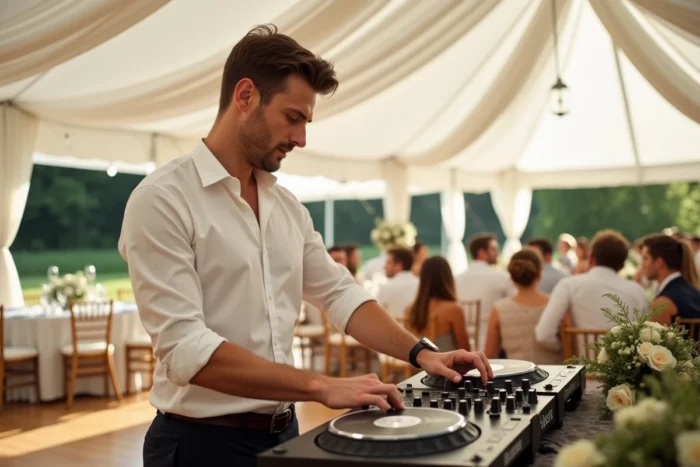
Choosing a DJ for a wedding involves weighing several variables, the relative importance of which changes depending on the venue, season, and format of the reception. Rather than listing generic advice, this article compares the criteria that truly impact the quality of the musical performance on the big day.
Regulatory Constraints of Reception Venues and DJ Equipment
Since 2024, several reception venues have implemented new environmental regulatory constraints that directly affect the DJ’s performance. Sound power limits, stricter end-of-evening hours, restrictions on smoke machines, encouragement of less energy-consuming equipment: these rules vary from one venue to another and significantly alter the sound and lighting output.
A DJ who has never worked in a venue subject to a decibel limit may underestimate the impact on the evening’s atmosphere. Conversely, a provider accustomed to these configurations adapts their equipment in advance (directional speakers, precise volume management by zones).
Before signing a contract, it is essential to cross-reference two pieces of information: the technical constraints of the venue and the DJ’s ability to meet them. If your venue imposes a sound limit or strict hours, ask the provider what concrete solutions they propose.
This technical exchange, often overlooked, distinguishes a seasoned professional from an entertainer who will discover the problem on the night itself. To deepen the selection process, knowing how to find a DJ for your wedding on La Mariée Rêveuse helps structure the initial steps.
Wedding DJ: Comparison of Selection Criteria by Reception Format
Not all weddings are alike, and the criteria for selecting a DJ vary greatly depending on the context. The table below compares three common formats and the associated points of vigilance.
| Criterion | Classic Wedding (100+ guests, weekend, venue) | Intimate Wedding (less than 50 guests) | Outdoor Wedding |
|---|---|---|---|
| Sound Equipment | Powerful sound system, subwoofer suitable for the space | Compact speakers, controlled volume | Directional sound, wind and dispersion management |
| DJ Experience | Crowd management, transitions between generations | Fine reading of a small group, ability to vary styles | Adaptation to weather uncertainties, electrical autonomy |
| Lighting | Light shows, projectors, possibly smoke machines | Subtle ambient lighting | Garlands, autonomous spots (frequent environmental constraints) |
| Coordination with the Venue | Standard, known rules | Atypical venue possible, essential technical verification | Noise permits, hours, electrical access to validate |
| Provider Availability | High demand on weekends during the season | More flexible, weekday dates often possible | Depends on the season and weather |
This comparison shows that the reception format determines the profile of the DJ to look for. A provider who performs well in front of 150 people in a venue may not necessarily be comfortable in a garden with 30 guests.
DJ Availability and Wedding Date: The Calendar Effect
Couples who choose an off-season or weekday wedding benefit from significantly increased availability of DJs. During high season (May to September, weekends), the most sought-after providers are fully booked several months in advance.
In contrast, a wedding on a Thursday in June or a Saturday in November opens up a range of possibilities. The DJ has more time to prepare the performance, discuss the playlist, and coordinate with other participants.
When to Contact the DJ to Book
The unspoken rule among music entertainment professionals is: the earlier the reservation, the wider the choice. For a wedding in high season, contacting providers at least eight to ten months before the date is a reasonable minimum. A weekday or off-season wedding allows for a shorter timeframe.
Technical Questions to Ask Before Signing with a Wedding DJ
The preliminary meeting with a DJ should not be limited to discussing musical styles. Here are the concrete points that reveal the provider’s level of professionalism:
- What sound and lighting equipment do they bring, and do they adapt it to the reception venue (power, type of speakers, electrical autonomy)?
- Have they previously worked in venues subject to sound power limits or environmental constraints?
- How do they manage coordination with the caterer, photographer, and master of ceremonies for key moments (entrance of the couple, first dance, bouquet toss)?
- Do they offer a backup plan in case of equipment failure (backup equipment, fallback solution)?
- Do they accept a list of requested songs and a list of songs to avoid, and how do they integrate them into their set?
A DJ who answers these questions precisely demonstrates a concrete experience in wedding entertainment. Vague or evasive responses regarding equipment and logistics indicate a lack of preparation.

The Shared Playlist: Personalization Tool or Trap
Many couples provide a playlist of desired tracks. This exercise is useful as long as it allows the DJ some room for adaptation. A good DJ adjusts the set in real-time according to the audience’s energy, not according to a fixed file.
Providing around twenty key tracks and a short list of songs to avoid gives the provider a clear framework without locking them in. Supplying a playlist of several hundred tracks has the opposite effect: the DJ loses their ability to read the room.
Wedding Musical Entertainment: What the Price Doesn’t Always Reveal
Comparing DJ rates without comparing the included services is like comparing catering quotes without reading the menu. Two providers at the same price can offer very different levels of service: duration of the performance, quality of sound and lighting equipment, presence or absence of stage lighting, time spent scouting the venue.
The price also does not reflect the preparation time involved. A DJ who spends several hours creating a personalized set, meeting with the couple, and coordinating with the venue provides a service whose cost is justified. The price of a wedding DJ covers the visible performance and all the invisible work beforehand.
Selecting a wedding DJ relies less on image or word-of-mouth than on verifying concrete technical points: suitability of equipment to the venue, management of regulatory constraints, ability to adapt the set in real-time. These elements, rarely spectacular, make the difference between a successful evening and an empty dance floor.