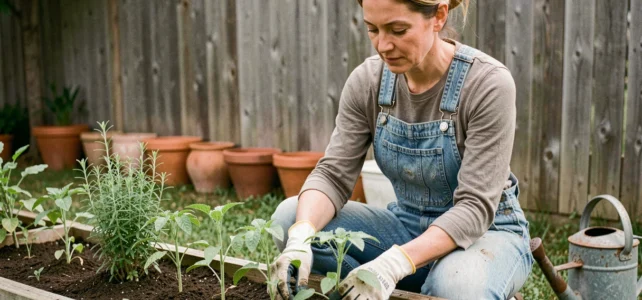
Clay soil that sticks to boots in March, a heatwave that scorches salads in July, frost on cabbages in November: each month imposes its own constraints on the garden. Rather than following a generic calendar, it’s better to think in terms of concrete problems and adapt actions to the signals from the ground.
Water restrictions and garden watering: what the law requires
Before discussing watering techniques, we need to address regulations. Since 2024, a significant portion of French territory regularly experiences prefectural orders that regulate the watering of private gardens according to four graduated levels: vigilance, alert, heightened alert, and crisis.
From the alert level, watering lawns is often prohibited between 8 AM and 8 PM. In a crisis situation, the irrigation of ornamental gardens may be completely suspended. An individual who waters despite these restrictions faces a 5th class fine that can reach 1,500 euros, increased to 3,000 euros in case of repeat offenses.
There are many practical guides available on the Jardiner Facile website for gardening, but the most useful reflex remains to check the level of restrictions in effect in one’s municipality before each heatwave. This administrative constraint changes the way we plan our plantings: it’s better to choose drought-resistant plants rather than rely on daily watering.
Rainwater harvesting: a regulated solution
Installing an outdoor tank not connected to the indoor network does not require any special formalities. However, any domestic well or borehole must be declared at the town hall since January 1, 2009, even if it is only used to water a vegetable garden. Failure to comply with this obligation exposes one to the same 5th class fine.
The recoverable volume from a roof is often underestimated. A tank of a few hundred liters, filled by spring and autumn rains, is sufficient to cover supplementary watering for a small vegetable garden during dry weeks.
Living soil and mulching: preparing the ground rather than fixing the damage
Gardeners often fertilize heavily in spring to compensate for soil depleted by winter. The problem is that bare soil for several months loses its structure: surface compaction, leaching of nutrients, disappearance of microfauna.
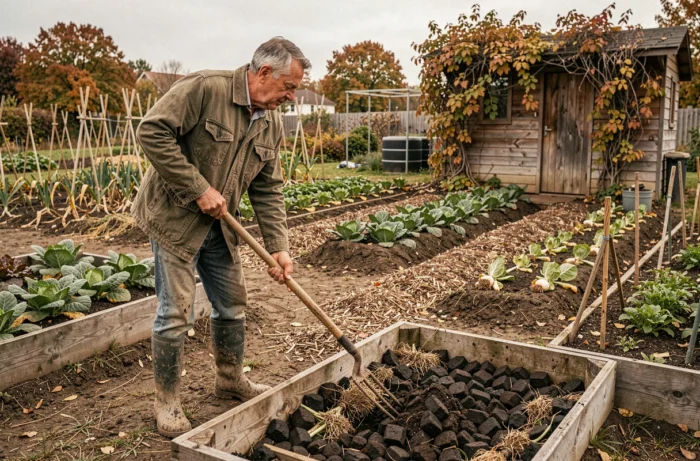
Mulching before winter protects the soil better than any spring recovery fertilizer. An organic mulch (dead leaves, branch chippings, straw) retains moisture, limits erosion, and feeds earthworms that naturally aerate the soil.
Adapting mulch to the season
- In autumn and winter, a thick layer of dead leaves or chippings protects roots from frost and decomposes slowly to enrich the soil in spring.
- In summer, a thinner mulch (dried grass clippings, straw) limits evaporation and reduces the frequency of watering, a direct advantage in the face of water restrictions.
- In the vegetable garden, alternating carbonaceous mulch (straw, cardboard) and nitrogenous mulch (clippings, fresh leaves) balances inputs without resorting to chemical fertilizers.
Opinions vary on the ideal thickness of mulch, as it depends on the type of soil and local climate. On clay soil, a layer that is too thick can retain excess moisture in winter. Adjustments should be made gradually by observing the condition of the soil beneath the mulch.
Crop rotation and associations in the vegetable garden for year-round vegetables
Planting the same vegetables in the same spot each year depletes the soil of specific nutrients and encourages pest establishment. Crop rotation, even in a small vegetable garden, breaks this cycle.
The principle is simple: vegetables are classified by families (nightshades, cucurbits, legumes, alliums) and their locations are rotated from year to year. Legumes fix nitrogen in the soil, benefiting the nutrient-hungry crops that follow, such as tomatoes or squash.
Staggering harvests throughout the year
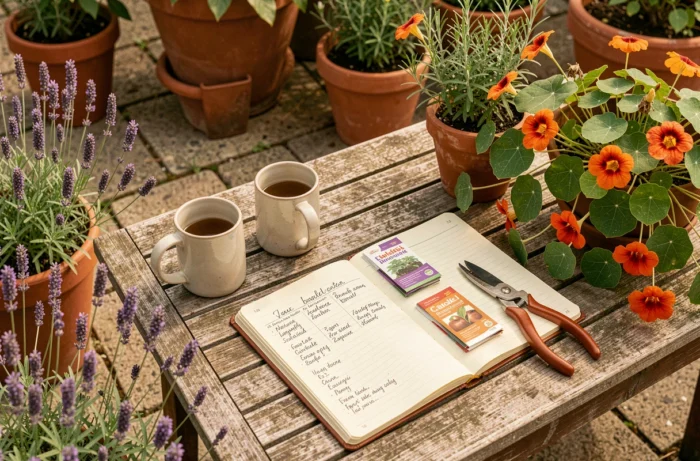
To harvest beyond summer, sow winter vegetables as early as July or August: lamb’s lettuce, spinach, leeks, cabbages. These crops withstand the cold and occupy the vegetable garden during months when it would otherwise remain empty.
Plant associations also play a concrete role. Marigolds at the foot of tomatoes repel certain nematodes. Basil planted near zucchinis attracts pollinators. These are not miraculous recipes, but complementarities that reduce interventions.
Pruning and plant maintenance: intervene at the right time rather than often
Pruning too early or too late does more harm than not pruning at all. Spring-flowering shrubs (forsythia, lilac) should be pruned just after flowering, not in autumn. Roses are pruned in late winter, when the buds begin to swell.
A clean and well-sharpened pruner limits the risk of disease much more than a phytosanitary treatment applied afterward. Disinfecting the blades between each shrub prevents the spread of fungi and bacteria from one plant to another.
Grass: reduce mowing frequency
Mowing too short and too often weakens the grass and encourages weed growth. Raising the cutting height by a few extra centimeters allows the blades to better withstand drought and naturally compete with weeds.
In the height of summer, spacing mowings to about ten days preserves soil moisture and reduces the lawn’s water stress. Longer blades shade their own roots, which decreases evaporation.
Every action in the garden benefits from shifting from automatic reflex to direct observation: leaf color, soil condition under the mulch, presence of beneficial insects. A productive garden year-round relies less on a fixed calendar than on the ability to read what the ground tells us, month after month.