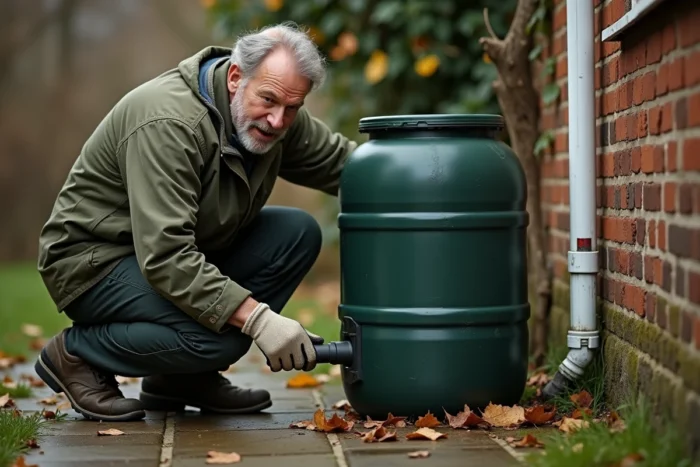
A rainwater collector installed for several months, or even years, that remains desperately empty after a rainy episode: the problem is rarely related to the tank itself. In the vast majority of cases, the malfunction lies upstream, between the gutter and the tank’s inlet. Precisely identifying the source of the failure prevents unnecessary replacement of parts or questioning the entire installation.
Collector in winter mode: the invisible cause of an empty water collector
The diversion kits sold with the collectors often include a winter mode that disconnects the gutter from the tank. This setting protects the installation from freezing and overpressure during the cold months. The problem arises in spring: if no one switches the collector back to “summer” mode, rainwater continues to flow down the gutter without ever reaching the tank.
This cause is documented in the manufacturers’ manuals, which explicitly recommend reactivating the inlet to the tank after winter. In practice, this is a common oversight, especially since the collector visually remains in place and shows no signs of malfunction. A quick check takes less than a minute: simply turn or reposition the collector’s flap according to the model.
When looking for solutions for a water collector on Instant Jardin, this point frequently comes up among the first reflexes to adopt before any disassembly.

Clogged collector filter and grille: when water stops flowing
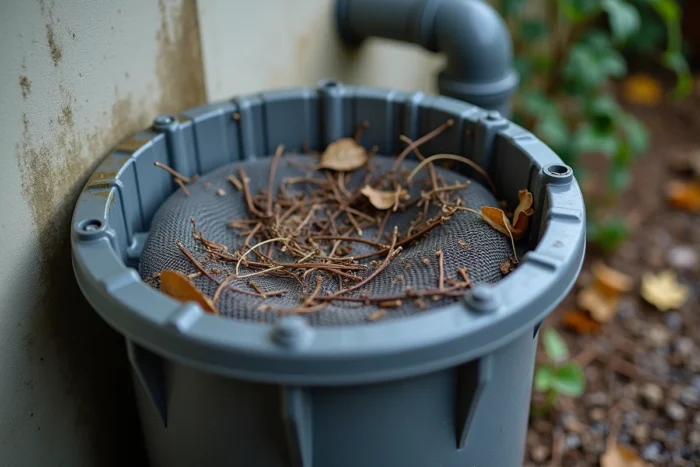
The second blockage point is at the filter integrated into the collector or the protective grille at the tank’s entrance. Dead leaves, plant moss, sand carried by runoff from the roof: debris accumulates within weeks and eventually forms a watertight plug.
The gutter flows normally, water runs down the downspout, but nothing enters the tank. The diagnosis is simple: remove the filter or grille and observe. If a compact mass of organic material blocks the passage, a rinse with clear water is enough to restore the flow.
Cleaning frequency based on the environment
A collector installed under a deciduous tree requires more regular checks than an installation on an open facade. Field reports vary on the ideal frequency, but cleaning at each season change is a reasonable minimum. Some collectors have removable filter baskets that make the operation tool-free.
- Check the collector filter at least at the beginning of each season (spring and autumn)
- Remove leaves and debris accumulated on the tank’s entrance grille
- Inspect the gutter itself, as a blockage upstream prevents water from reaching the collector
- Rinse the filter with clear water rather than scraping it, to avoid damaging the mesh
Slope issue and connection between gutter and tank
When the collector is open and the filter is clean, the failure may come from a slope defect or a poorly positioned connection. Rainwater flows by gravity: if the connecting pipe between the collector and the tank has a slight upward slope, water stagnates in the pipe instead of flowing into the tank.
This problem sometimes appears after soil settling under the tank or after an unintentional movement of the collector (shock, wind, handling). The connecting pipe must maintain a continuous downward slope from the collector to the tank’s inlet. A level placed on the pipe allows for a quick check of the inclination.
Connection and sealing of the collector
A collector punctured in the gutter at an inappropriate height can also limit filling. If the diversion hole is too high compared to the water flow in the downspout, only heavy rains generate enough flow to reach the collection point. Light rains, which account for the majority of precipitation throughout the year, then pass without being captured.
The position of the collector on the downspout should be checked against the maximum filling level of the tank. A collector placed too low may also cause backflow when the tank is full.
Overflow and slow leak: the tank empties as quickly as it fills
In some cases, the collector does receive rainwater but a leak at the draw-off tap or overflow prevents the level from rising. A tap that does not close completely, a degraded connection seal, or a poorly oriented overflow pipe is enough to gradually empty the tank between rain episodes.
The diagnosis involves direct observation after a rain. If the level rises during the downpour and then drops in the following hours, the leak is confirmed. Each outlet point of the tank must then be inspected.
- Draw-off tap: check that the internal seal is not cracked or dirty
- Overflow connection: ensure that the pipe is directed towards the drainage and not towards the ground at the foot of the tank
- Tank wall: on plastic models exposed to sunlight, micro-cracks may appear after several years
An empty rainwater collector almost always tells the same story: an upstream element of the tank blocks or diverts the flow. The forgotten collector in winter mode, a clogged filter, a slope defect, or a discreet leak cover the overwhelming majority of situations. Before considering equipment replacement, a methodical inspection of the circuit, from the gutter to the draw-off tap, usually suffices to locate the problem and resolve it at no cost.