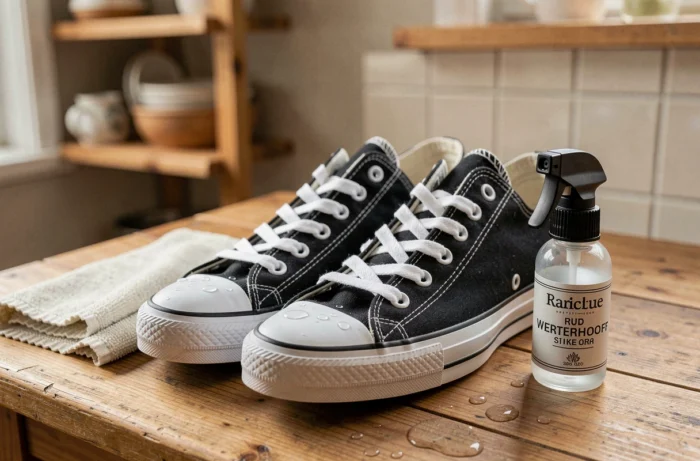
The cotton canvas of Vans Old Skool absorbs water within seconds. Without appropriate treatment, the upper becomes saturated with moisture, the foxing tape peels off prematurely, and the suede of the heel counter marks irreversibly. Waterproofing your Vans Old Skool is not just about comfort: it is a maintenance operation that directly affects the lifespan of the pair.
PFAS Regulation 2026 and Impact on Sneaker Waterproofing Sprays
Most high-performance water-repellent sprays sold in Europe rely on fluorinated compounds, PFAS. Starting from October 10, 2026, the European regulation limits the use of PFHxA (undecafluorohexanoic acid) in consumer products, including shoe sprays. Any product exceeding 25 ppb of PFHxA will no longer be marketed in the EU.
The French Parliament has also passed a specific law that will impose restrictions on the manufacture and sale of products containing PFAS for textile and shoe maintenance starting in 2026. In practical terms, several popular references used to waterproof canvas or suede sneakers will need to modify their formulations or disappear from the market.
For owners of Vans Old Skool, this means you need to anticipate now. Fluoropolymer-based sprays (often labeled “nano-protection”) are the first to be affected. We recommend checking the composition before purchase and opting for PFAS-free formulations based on silicone or acrylic polymers, which remain permitted.
Those who wish to understand in detail how to waterproof Vans Old Skool will find useful additional information on methods compatible with these new regulatory constraints.
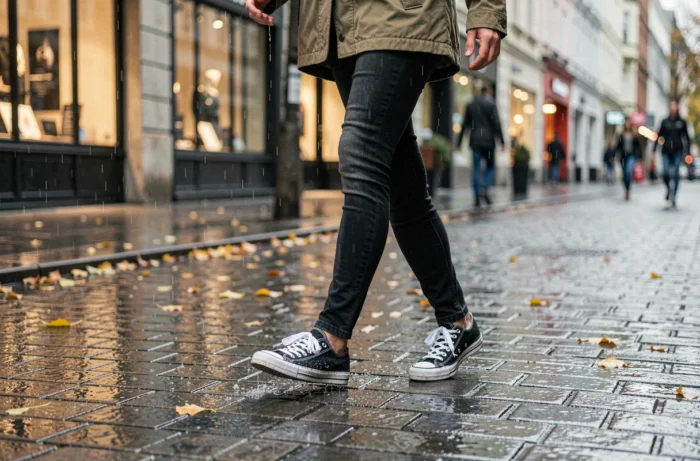
Silicone Spray, Acrylic Polymer, or Wax: Which Treatment to Choose for Old Skool Canvas
The upper of the Old Skool combines a cotton canvas with suede inserts on the quarter panel and the side stripe. These two materials do not react the same way to waterproofing agents, and this is where many treatments fail.
Silicone Spray on Canvas
Silicone creates a hydrophobic film on the surface that beads water without altering the color or flexibility of the canvas. It is the most versatile treatment for a textile-dominant Old Skool. Silicone remains effective on canvas without changing the hue.
Its limitation: it wears out quickly due to mechanical friction. On a pair worn daily, the protection diminishes within a few weeks. It is necessary to renew the application regularly.
Acrylic Polymer on Suede
The suede inserts of the Old Skool require a different treatment. Acrylic polymers penetrate the fibers deeply instead of remaining on the surface. They offer more durable protection than silicone on this material, without stiffening the suede.
We observe that sprays combining silicone and acrylic polymer yield the best results on the Old Skool, precisely because they treat both the canvas and the suede simultaneously. Provided that the material is not saturated: two thin layers are better than one thick layer.
Waterproofing Wax
Wax should be avoided on light canvas Old Skool. It visibly darkens the fabric and creates a waxy finish that alters the appearance of the canvas. On a black pair, the result is acceptable. On off-white or marshmallow, the result is unacceptable. Wax remains relevant only on full leather models, not on the canvas/suede mix of classic Old Skool.
Preparing the Pair Before Waterproofing: Technical Mistakes to Avoid
Applying a spray on a dirty or damp pair is the primary cause of treatment failure. The waterproofing agent binds to dust residues instead of penetrating the fibers, and the protective film forms unevenly.
- Remove the laces and insoles before any operation. Cotton laces absorb the spray and become rigid, creating friction points on the eyelets
- Clean the canvas with a soft brush and a specific sneaker cleaner (no Marseille soap, which leaves a greasy film incompatible with most waterproofing agents)
- Let the pair dry at room temperature for at least twelve hours. Any residual moisture prevents the treatment from adhering
- Protect the vulcanized rubber sole with masking tape. The spray is ineffective on the waffle sole and can leave a white film on the foxing tape
This protocol takes time, but it conditions the effectiveness of the treatment. We find that the majority of negative feedback on waterproofing sprays is related to insufficient preparation, not the product itself.
Renewal Frequency and Signs of Wear of the Treatment on Vans Old Skool
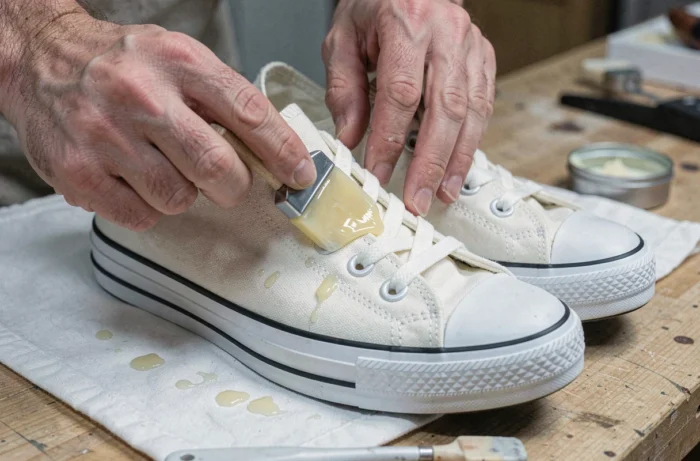
A waterproofing treatment is not permanent. On a pair of Vans Old Skool worn several times a week, the protection significantly decreases after three to four weeks of active wear. The test is simple: drop a few drops of water on the canvas. If the water beads and rolls off, the treatment is holding. If it spreads and begins to soak into the fabric, reapplication is necessary.
Some factors accelerate wear:
- Repeated friction between the canvas and jeans or pants abrades the protective film on contact areas (shoe collar, quarter panel)
- Prolonged UV exposure degrades the polymers. A pair left in the sun between wears loses its protection faster
- Successive cleanings partially eliminate the treatment. After each wash, even gentle, reapplication is required
For models worn occasionally, a treatment every two months is sufficient. For a daily pair, we recommend a cycle every three weeks, in thin layers and outdoors to avoid inhalation.
The switch to PFAS-free formulations does not fundamentally change this rhythm. Current silicone sprays offer comparable durability to the old fluorinated formulations on canvas. The difference mainly lies in the suede, where fluorine-free acrylic polymers sometimes require an additional layer to achieve the same level of water repellency.