Interior and exterior decoration is undergoing a discreet yet tangible phase of transformation. Color palettes are evolving, materials are changing status, and a European regulatory framework is beginning to influence furniture choices. Understanding these movements allows for decoration choices that stand the test of time, rather than following short-lived trends.
European Regulation ESPR and Decoration: What Changes for Furniture
This topic often goes under the radar of most decor guides, but it is already conditioning the available offerings in stores. The European regulation ESPR (No. 2024/1781), which came into effect on July 18, 2024, replaces the old eco-design directive that only targeted energy-related products.
Furniture is part of the second wave of implementation. A delegated act is expected around 2028, with obligations concerning the durability, reparability, and recyclability of furniture and decorative objects sold in the European Union.
In practical terms, this means that low-cost, short-lifespan furniture pieces may become more difficult to market. For anyone investing today in a sofa, a garden table, or indoor storage, prioritizing repairable pieces made from recyclable materials is no longer just an aesthetic choice. It is also anticipating a regulatory framework that will tighten.
Anyone considering rethinking their living room, terrace, or bedroom will benefit from consulting the decor on the L’Atelier du Bricolage website to combine visual inspirations with technical sheets on sustainable materials.
Earthy Palettes and Bio-Sourced Textures: The 2026 Decor Shift
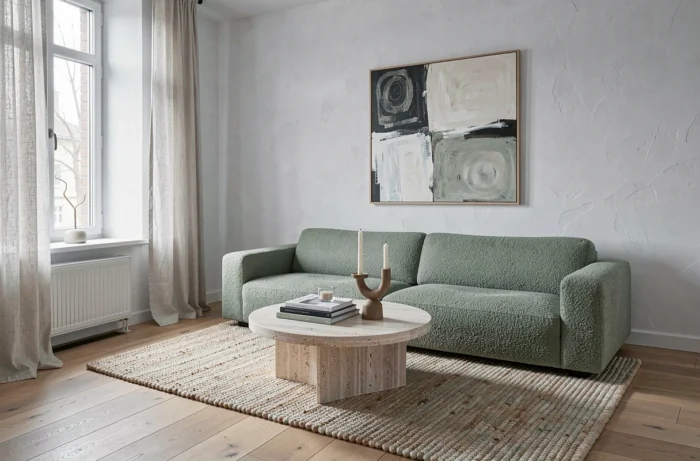
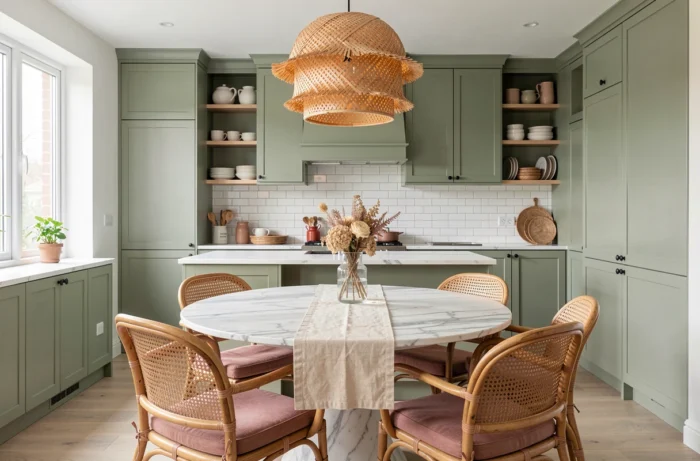
Since the summer of 2026, several trend analyses describe a clear retreat from cool shades (duck blue, mustard yellow) in favor of earthy, warm, and enveloping palettes. Soft ochres, warm browns, sage greens, and softened terracotta now form the chromatic base of both interiors and outdoor spaces.
This shift is not limited to wall colors. It is accompanied by a change in materials. Linen, rattan, raw wood, and polished concrete are gradually replacing smooth surfaces and shiny finishes. The space, whether it’s a living room, kitchen, or terrace, gains tactile relief.
Fewer Objects, More Quality per Piece
The key takeaway from recent analyses can be summed up in one phrase: material sobriety rather than decorative accumulation. Fewer objects on shelves, but pieces chosen for their texture, origin, and ability to age.
A raw stoneware vase, a woven fiber basket, a turned wood light fixture bring more character than a collection of mismatched accessories. This logic works just as well in a bedroom as in a garden, where a solid wood bench placed on gravel creates a more effective focal point than an accumulation of decorative pots.
Modularity of Interior and Exterior Spaces: A Structuring Criterion
The trends for 2026-2027 emphasize modularity as a strong marker of decoration. Multifunctional furniture and storage integrated into architecture are no longer just gadgets. They respond to a real constraint: living spaces are not increasing, and the uses of the same space are multiplying.

A living room serves as an office during the day, a cinema room in the evening, and a play area on weekends. A terrace becomes a dining room, a reading lounge, and then a reception area. The design must accommodate these transitions without requiring a complete rearrangement with each change of use.
Concrete Criteria for Modular Furniture
- The modular sofa with detachable elements allows for reconfiguring the living room according to the number of occupants, without moving heavy furniture
- Extensible tables with integrated extensions work well both in the kitchen and on the terrace, provided a material resistant to temperature variations is chosen
- Stackable or folding seats in treated wood or metal serve both indoors and outdoors, and can be stored without taking up floor space
- Planters on wheels or mobile vegetated screens redefine areas of a garden or balcony according to the season
Modularity also concerns storage. Adjustable shelving units, built-in cabinets under stairs, or dual-purpose terrace chests (seating and storage) reduce the need for additional furniture.
Outdoor Decoration: Consistency Errors Between Garden, Terrace, and Interior
The continuity between interior and exterior decoration lies in details that many overlook. The first trap is the palette break. A living room in warm tones (linen, terracotta, light wood) that opens onto a terrace furnished in anthracite gray resin creates an immediate visual dissonance.
The second trap concerns the scale of objects. A small side table that works in a bedroom seems lost on a large terrace. Conversely, an oversized outdoor sofa overwhelms a balcony of just a few square meters. Adapting the scale of furniture to the actual surface of each space remains the most frequently transgressed rule.
Dual-Use Materials: What Really Holds Up Outdoors
- Solid teak withstands the elements without treatment and ages beautifully, making it suitable for a terracotta or raw wood style both indoors and outdoors
- Polished concrete can handle thermal variations on a covered terrace but cracks in full sun without appropriate protection
- Natural rattan remains an indoor or veranda material: exposed to rain, it degrades in just a few seasons
Before choosing a material for an outdoor space, checking its behavior against UV and humidity can prevent costly replacements. Field reports vary on the durability of high-density synthetic rattan outdoors, depending on exposure and local climate.
Successful decoration relies less on the accumulation of ideas than on the coherence of choices. A consistent thread of material-color-scale between each piece and each outdoor space produces a more refined result than ten Pinterest inspirations juxtaposed without connection. The European regulatory framework, the rise of bio-sourced materials, and the constraint of surface area guide these choices in a precise direction, which is worth understanding before purchasing any furniture.