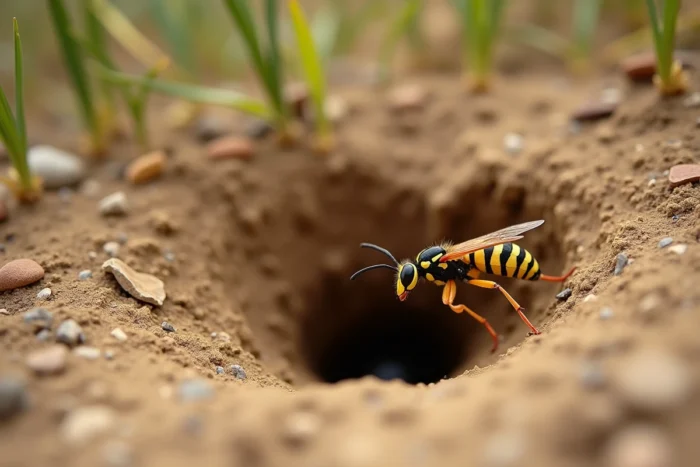
A small round hole in the lawn, striped insects coming in and out non-stop: this scene often surprises during gardening. Before panicking or grabbing an insecticide spray, the first step is to understand what is actually living under your feet. Not all wasps nesting in the ground pose the same level of risk, and some are not even social wasps.
Solitary Wasp or Social Nest in the Ground: The Confusion Leading to Unnecessary Destruction
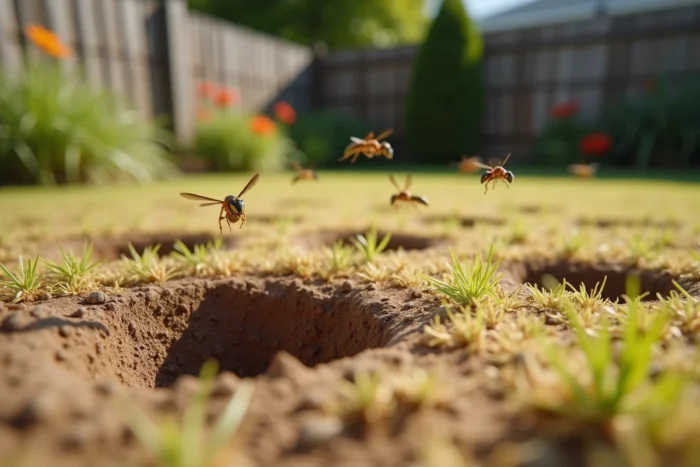
Have you spotted several small holes in a sandy area of the garden? There is a good chance they are solitary digger wasps. These insects each dig their own burrow to lay eggs. Their behavior is calm, almost indifferent to your presence.
The nest of a social colony, on the other hand, is identified differently. A single main hole with a continuous flow of many individuals is a sign of a social wasp nest (genus Vespula, for example). The visual difference is clear: on one side, dozens of small holes scattered with little simultaneous activity; on the other, a single opening that concentrates constant traffic.
This distinction changes everything. Destroying a grouping of solitary wasps means eliminating useful garden helpers that pollinate and regulate other insects. Knowing how to identify a ground wasp in the soil prevents unnecessary and sometimes costly interventions.
Concrete Clues to Spot an Active Wasp Nest in the Ground
Observation is the most reliable method. It requires no equipment, just a few minutes of patience from a reasonable distance.
What You See at Ground Level
A mound of fine soil around a hole a few centimeters in diameter is the first clue. The displaced soil resembles that found at the exit of a rodent burrow, but wasps move it in finer and more regular grains.
The back-and-forth is the decisive criterion. Stand at least three meters from the suspicious hole and observe for five minutes. If insects are continuously entering and exiting, like on a landing strip, it is an active social nest.
What You Hear and Feel
In warm weather, a dull buzzing can be heard as you approach the ground. Social wasps defend their nest: if you pass nearby regularly and individuals come to circle around you, it is a warning sign. The further into the season, the larger the colony grows, and the more intense the defensive reaction becomes.
- Single hole of a few centimeters with fine soil ejected around
- Continuous and simultaneous traffic of several individuals at the same entry point
- Aggressive reaction when approaching within two meters
- Buzzing audible at ground level in warm weather
Lawn Mower and Wasp Nest in the Ground: A Common Trap in the Garden
Gardening equipment is the leading cause of the sudden discovery of an underground nest. The vibrations from the mower, string trimmer, or lawn tractor trigger an immediate defensive reaction from the colony. The risk of a massive attack is real when the machine passes, sometimes resulting in dozens of stings in just a few seconds.
Pest control professionals now recommend a simple habit: before mowing, take a visual tour of the area. Spot suspicious holes and insect pathways. If you identify an active point, mark the area (a stake, a ribbon) and do not mow until the nest has been treated.
This precaution is particularly valid between June and September, when colonies reach their maximum size. In spring, a newly forming nest may only have a queen and a few workers. In the height of summer, the underground population can be considerable.

Reacting to a Wasp Nest in the Ground Without Making the Situation Worse
The most dangerous reflex is also the most common: blocking the hole. Never obstruct the entrance of an active nest in the ground. Wasps can dig a new exit, sometimes leading into a house, under a terrace, or into a crawl space. The problem moves instead of disappearing, making it much harder to manage.
Observation Phase Before Any Decision
Take the time to note the exact location, level of activity, and proximity to high-traffic areas (driveway, terrace, playground). A nest located at the back of the garden, far from any passage, does not present the same urgency as a nest two meters from the front door.
Some useful questions to assess the situation:
- Is the nest located less than five meters from a living area or regular passage?
- Are there children, pets, or allergic individuals in the household?
- Is the nest in an area you need to maintain (lawn to mow, vegetable garden)?
If the answer is yes to any of these questions, a quick intervention is justified.
Professional Intervention or Self-Management
An active underground nest in a frequented area requires a professional. The aerosol insecticides sold in stores do not reach the heart of a buried nest, which can extend several dozen centimeters deep in a network of galleries. A pest control technician uses suitable products, injected directly into the gallery, and preferably intervenes at the end of the day when most workers have returned to the nest.
If the nest is far from any passage area and no one in the household is allergic, temporary coexistence remains an option. Social wasp colonies die naturally with the first frosts. Only young queens survive by hibernating elsewhere, and the nest will not be reused the following year.
The season determines the size of the colony and the level of risk. A nest discovered in May with a few individuals is much less threatening than a nest in August with a fully populated colony. When in doubt, distance remains your best ally: mark the area, keep children and pets away, and have a specialist assess the situation before taking action.