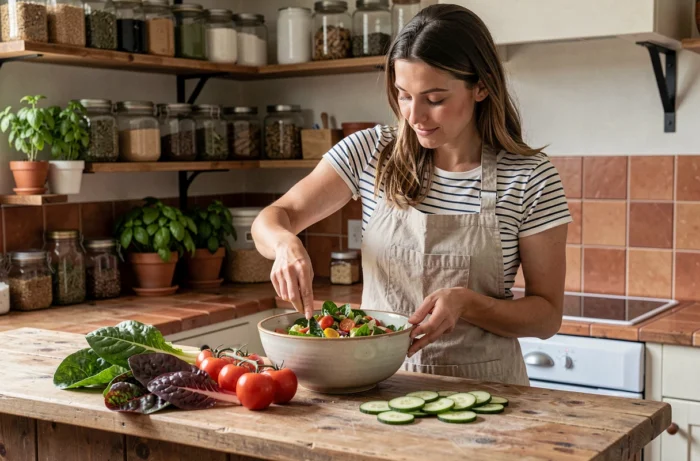
Organic products are increasingly taking up space on French shelves, including in ready-to-use industrial ranges. The agri-food industry is massively using organic raw materials for its processed products, blurring the line between homemade cooking and prepared dishes. This reality raises a concrete question: when time is short, should one cook with fresh organic products, turn to ready-made organic meals, or combine both approaches?
Fresh and ultra-fresh organic products: what really drives the market
The ultra-fresh section is the main growth driver in organic stores in France. Yogurts, pre-cut vegetables, ready-to-eat salads: these products appeal because they reduce preparation time without sacrificing the organic label.
The phenomenon goes beyond a niche. The U cooperative has recently expanded its plant-based range, a sign that large retailers are capturing this demand for practical and quick-to-prepare organic products. Specialized brands are no longer the only ones offering ready-to-use organic ingredients.
By exploring the cooking ideas from Le Bio du Coin, one can measure the diversity of recipes that can be made with fresh organic products available through short supply chains. The challenge is not to do everything oneself, but to identify the right shortcuts.
Local origin of organic ingredients: what French law changes in 2026
France has strengthened its requirements for the origin labeling of food products in 2026. The law now imposes more precise mentions regarding the origin of raw materials, including for processed organic products. A prepared dish labeled organic does not necessarily indicate where its vegetables or grains come from.
Reading the label of a processed organic product is no longer sufficient: it is necessary to check whether the local origin is actually mentioned or if the term “organic” masks a distant supply. Field reports vary on the ease of accessing this information in stores.
Short organic supply chains and real traceability
An organic vegetable grown 30 kilometers from your home and an organic vegetable imported from another continent carry the same label. The difference lies in traceability, not certification. AMAPs, farmers’ markets, and local producers’ stores remain the channels where the origin is verifiable without ambiguity.
For daily organic cooking, favoring short supply chains reduces uncertainty about origin but imposes a constraint: adapting recipes to the products available, thus to the season.
Quick organic recipes: balancing homemade and semi-prepared
Cooking organic every evening with fresh products requires time. During the week, the most realistic compromise combines three levels of preparation.
- Raw bases for quick cooking: red lentils, bulgur, quinoa. These organic legumes and grains cook in under fifteen minutes and serve as a foundation for a complete meal with roughly chopped seasonal vegetables.
- Semi-prepared organic products: hummus, pestos, jarred tomato sauces, pre-sliced frozen organic vegetables. They avoid the most time-consuming steps without resorting to an entirely industrial dish.
- Ready-to-heat organic meals: soups, stir-fries, gratins. Useful in emergencies, but their composition deserves careful attention to the ingredient list and the origin of the raw materials.
A realistic organic meal during the week combines quick raw products and one or two semi-prepared shortcuts. Wanting to do everything from scratch every evening often leads to abandoning organic out of fatigue.
Organic batch cooking: a method that works under conditions
Preparing the bases for several meals (cooked grains, roasted vegetables, sauces) in one weekend session reduces daily time to about ten minutes of assembly. The method works if the recipes remain simple and if the storage containers are ready.
The main limitation: batch cooking requires planning a weekly menu. Without this step, bulk-bought organic ingredients end up wasted. Planning organic meals for the week avoids waste as well as evening decision fatigue.

Plant-based organic cooking: a trend that restructures everyday recipes
Combining organic food with a reduction in animal proteins generates documented benefits for health and the environment, according to studies reported by the French Ministry of Agriculture on dietary recommendations. Organic plant-based recipes are no longer confined to strict vegan diets.
Everyday dishes are adapting: an organic lentil dahl, a stir-fry of chickpeas with grilled vegetables, a squash gratin with local goat cheese. These recipes require neither rare ingredients nor complex techniques. They rely on legumes, whole grains, and seasonal vegetables.
- Replacing meat with organic legumes (lentils, beans, chickpeas) in two to three meals per week reduces grocery costs without sacrificing protein intake.
- Organic condiments – miso, tahini, tamari – transform a simple vegetable dish into a tasty meal. An initial investment that lasts several weeks.
- Organic flax, pumpkin, or sunflower seeds add texture and nutrients to a salad or a bowl of grains without additional preparation time.
The most sustainable plant-based organic recipes for everyday use are those that require fewer than ten ingredients. Complexity discourages, simplicity prevails.
Industrial organic and homemade organic: the limits to know
The French agri-food industry uses organic raw materials on a large scale. An organic cookie, an organic frozen pizza, an organic cereal bar remain processed products. The label guarantees the absence of synthetic pesticides and compliance with a specification on inputs, not the overall nutritional quality of the finished product.
The available data do not allow for concluding that all processed organic products are nutritionally superior to their conventional homemade counterparts. A chocolate cake made with organic flour, organic butter, and organic sugar remains a cake high in sugar and fat.
The organic label pertains to the mode of production, not the nutritional balance of the final dish. Keeping this distinction in mind helps avoid confusing “organic” with “healthy” when filling your cart or choosing a recipe.