
When looking to build a house, you quickly come across a handful of names that appear everywhere: Hexaom, Maisons Pierre, Babeau-Seguin. However, the French market for new individual house construction gives a misleading image of concentration. The national leader captures only a modest share of the total volume, and the vast majority of projects are carried out by small local structures.
RE2020 strengthened in 2026: the filter that reshapes the map of builders
You may have noticed that commercial brochures all highlight the “low carbon house”? This is not an empty marketing argument. The environmental regulation RE2020, which is being gradually implemented, imposes increasingly strict thresholds for carbon sobriety and energy performance.
In 2026, these requirements will escalate. To comply, a builder must master their entire chain: selection of bio-sourced materials, thermal calculation from the design stage, partnerships with suppliers capable of producing compliant components. Large national networks have a structural advantage here. They can standardize low carbon construction processes across hundreds of simultaneous projects, which reduces the unit cost of compliance.
To understand how the network of new individual house builders operates, one must look beyond simple rankings by revenue. The ability to integrate the strengthened RE2020 into an accessible offer becomes a survival criterion, not a luxury.
Independent artisans and project managers, on the other hand, must absorb these compliance costs without economies of scale. Some manage to do so brilliantly on high-end projects. For entry-level houses, however, structured networks gain an advantage in regulatory terrain.
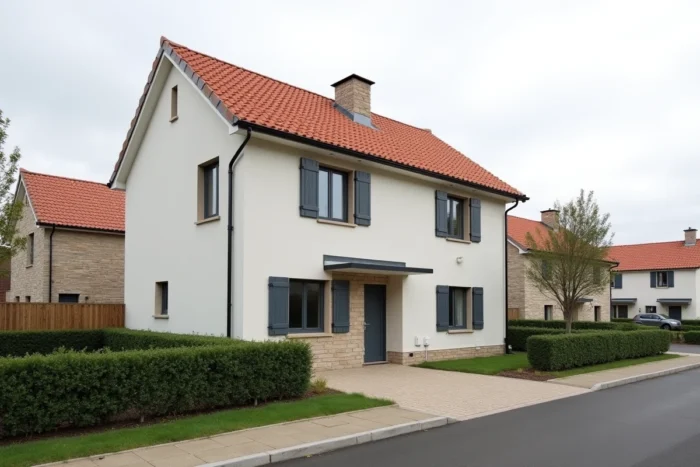
Concentration of the individual construction market: a fragile leader and TPEs everywhere
The Hexaom group (formerly Maisons France Confort) is regularly presented as the sector leader. However, its market share remains limited to about one-tenth of the national volume. This figure says a lot: no player truly dominates individual house construction in France.
TPEs (very small enterprises) represent more than four out of five companies in this sector. In other words, the market resembles a mosaic of small local players rather than a structured oligopoly. Behind Hexaom, brands like Babeau-Seguin, Maisons Pierre, or Maisons d’en France hold significant positions, but their territorial coverage varies greatly from region to region.
Why this fragmentation persists
Building an individual house remains a deeply local activity. The land, urban planning rules, available artisans, architectural habits: everything changes from one department to another. A national network wanting to establish itself in a new area must recreate a complete ecosystem of reliable subcontractors locally.
The recent crisis has accentuated this fragility. The liquidation of Geoxia (Maisons Phénix) in 2022, followed by the judicial recovery of AST Groupe, the third-largest French builder, shows that even big names are not immune to a sudden downturn. The volumes of new individual houses have been reduced by more than half from their pre-crisis levels to recent figures.
PTZ on new houses: the return of a game-changing lever
The Zero Interest Loan has been reopened for new individual houses, and this change reconfigures the competition among builders. Why? Because the PTZ is not automatically granted. The project must meet energy performance criteria, and the overall financial setup (PTZ, social accession loan, local aids) requires specific engineering.
Networks capable of offering a CCMI package with integrated financing gain a direct commercial advantage. A buyer who approaches a structured builder leaves with a complete simulation: land, RE2020 compliant house, activated “green” PTZ, calculated monthly payments. With an independent artisan, this work often falls on the client themselves or their broker.
- The CCMI (Contract for the Construction of Individual Houses) guarantees a fixed price, a delivery guarantee, and a ten-year warranty, regardless of the chosen builder.
- The PTZ reopened for new houses imposes energy performance levels compatible with RE2020, favoring builders already equipped to meet these requirements.
- Local aids (regional, municipal) vary greatly depending on the geographical area and complicate clarity for first-time buyers.
A selection effect in progress
This context favors a form of gentle concentration. The builders who survive the current crisis are those who combine three capabilities: RE2020 compliance, mastery of financial structuring, and solid territorial anchoring. Well-managed regional franchises (like Maisons Arlogis or Habitat Concept) are managing to stand out by pooling management tools and commercial training while maintaining local flexibility.

Choosing an individual house builder: what matters beyond size
The size of a network does not predict the quality of a project. The legal framework of the CCMI offers an identical protection base, whether the builder is a national group or a departmental player. What concretely differentiates experiences are less visible elements.
- The quality of the site manager assigned to the project: a single contact who oversees too many simultaneous projects degrades responsiveness.
- The network of local subcontractors: a builder established for a long time in an area has seasoned partners, which limits defects.
- The actual delay between signing and handing over the keys: the timelines announced in commercial brochures often underestimate administrative delays (permits, connections).
- Transparency regarding “off-contract” items: fencing, landscaping, network connections, which can represent a significant budget.
Checking the number of ongoing projects per site manager remains the best on-the-ground indicator before signing. Serious builders agree to communicate this information.
The French market for new individual house construction is undergoing a phase of reorganization. The players who emerge strengthened from this period will not necessarily be the largest, but those who have managed to articulate regulatory compliance, financial support, and execution rigor on the ground.