
Two forms of the verb to be, just one letter apart, yet with a radically different meaning. “I will be” and “I would be” pose a recurring problem in written French, even among experienced speakers. The confusion arises from the phonetic proximity between the simple future and the present conditional, two tenses that differ in the first person singular only by a final “s”.
Simple future and present conditional of the verb to be: comparative table
Before analyzing the contexts of use, a look at the complete conjugation allows us to identify where the differences between the two tenses lie.
| Person | Simple future (indicative) | Present conditional |
|---|---|---|
| I | will be | would be |
| You | will be | would be |
| He / She | will be | would be |
| We | will be | would be |
| You (plural/formal) | will be | would be |
| They | will be | would be |
In the first person, the ending changes from -ai (future) to -ais (conditional). In the other persons, the distinction is clearer in speech: “will be” versus “would be”, “will be” versus “would be”. It is precisely this clarity that provides the most reliable substitution test.
Understanding the difference between I will be and I would be relies on this mechanism: replacing “I” with “he” or “we” makes the difference audible and removes any ambiguity.
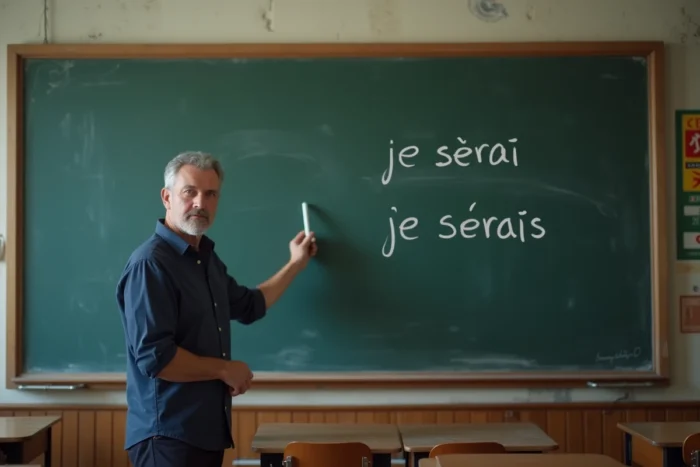
When the final “s” changes the meaning of the sentence
The simple future indicative expresses a future action presented as certain. The speaker commits to what will happen, without any prior condition.
- “Tomorrow, I will be available from noon.” – The commitment is firm, availability is announced as a fact.
- “I will be happy to welcome you.” – The phrase, common in professional correspondence, asserts a future state without reservation.
- “In three years, I will be graduated.” – The speaker projects a result they consider assured.
In contrast, the present conditional introduces a hypothesis, a wish, or a polite expression. The action is not guaranteed: it depends on a condition, either expressed or implied.
- “I would be available if the meeting were rescheduled.” – Availability is subject to an explicit condition.
- “I would be happy to help you.” – Politeness softens the assertion, the speaker is being delicate rather than categorical.
- “If I were you, I would be more cautious.” – The advice is based on a hypothetical situation.
The difference in meaning is considerable. Writing “I will be available if the meeting were rescheduled” produces a grammatical inconsistency: the future indicative does not associate with a subordinate clause introduced by “if” followed by the imperfect. The conditional is mandatory after “if” + imperfect.
Substitution test using the third person
The most economical method to decide is to replace “I” with “he” or “she”. The change of person makes the ending audible.
Applying the test in two steps
Let’s take the sentence: “Tomorrow, I will be/would be traveling.”
Replace with “he”: “Tomorrow, he will be traveling” sounds correct, while “he would be traveling” introduces a doubt that does not match the context. The simple future prevails, therefore “I will be” without “s”.
Another example: “If I had the choice, I will be/would be in the countryside.” The replacement gives “he would be in the countryside,” which fits the hypothetical structure. The conditional prevails, so “I would be” with an “s”.
Why this test works every time
In the third person, the simple future ends with “-a” (will be) and the conditional with “-ait” (would be). This difference in sound is impossible to confuse, even for a speaker who hesitates in writing in the first person. The test exploits a phonetic asymmetry absent in “I”.
This reasoning applies to all first-group verbs and beyond. “I will speak” or “I would speak” can be verified in the same way: “he will speak” versus “he would speak”.

Common mistakes in written correspondence and emails
Confusions between the future and the conditional are not limited to school dictation. They appear massively in professional exchanges, where the register of politeness blurs the markers.
In an email, “I will be available for a call” asserts certainty. “I would be available for a call” softens the wording, suggesting an openness rather than a firm commitment. Both are correct, but the choice between future and conditional changes the tone of the message.
The most common trap is to use the future in a conditional sentence. “If you agreed, I will be present” is incorrect. The subordinate clause in “if” + imperfect requires the conditional in the main clause: “I would be present”.
Conversely, a sentence without condition that uses the conditional unnecessarily weakens the statement. “I would be at the conference next Tuesday” implies doubt, whereas the speaker wants to confirm their presence. Without condition or hypothesis, the simple future is the correct form.
The arrival of mobile applications for French conjugation, widely disseminated in recent years, has changed verification practices. Consulting a conjugator in real-time has become common, but understanding the grammatical mechanism remains the only way to choose the correct form without a tool at hand. A conjugator provides the ending, not the context of use.
The distinction between “I will be” and “I would be” ultimately comes down to a question of posture: to affirm or to suppose. When the sentence expresses a forthcoming fact, the future prevails. When it formulates a hypothesis, a wish, or politeness, the conditional takes over. The third-person test resolves the issue in seconds, with no known exceptions.