
Burglaries targeting professional premises saw a notable increase during the summer of 2026, with nearly 9,000 professional premises affected in just one month according to data reported by the press based on police and gendarmerie statistics. Warehouses, often under-occupied during holidays and filled with high-value goods, are among the preferred targets. This reality necessitates going beyond generic recommendations to examine actual vulnerabilities and appropriate responses.
Seasonal Vulnerabilities of Warehouses: A Blind Spot in Security
Most security guides treat the protection of a warehouse as a static device. Cameras are installed, alarms configured, access control set up. The problem arises when human activity in the building decreases.
During summer holiday periods, reduced staffing creates windows of opportunity. Loading areas sometimes remain open longer than necessary, internal rounds become less frequent, and closing procedures are applied less rigorously.
Adapting the level of security to the operational calendar is a rarely formalized measure. This involves defining a seasonal protocol: reducing the number of active entry points, activating additional motion detectors in areas usually occupied, and daily checking of surveillance systems by a designated responsible person.
To effectively secure a warehouse, locksmithing serves as the first physical barrier, but its effectiveness directly depends on the rigor of the accompanying human procedures.
Cybersecurity of Connected Surveillance Systems in Warehouses
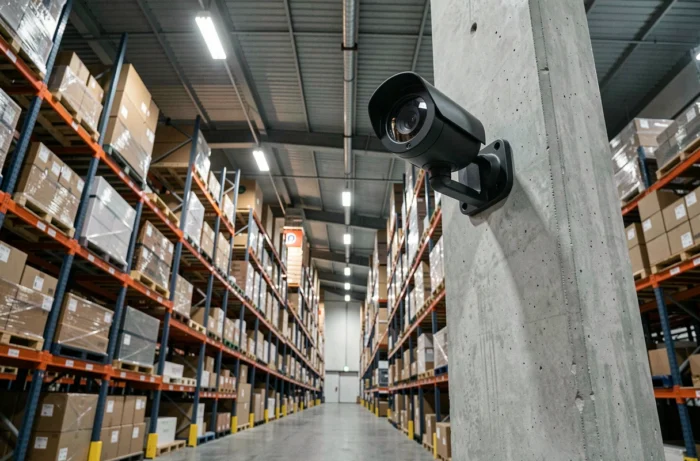
Physical protection devices (IP cameras, IoT sensors, connected alarm systems) are now controlled via network interfaces. This connectivity opens a second front of vulnerability that traditional warehouse security approaches almost systematically ignore.
Documented incidents in the transport and logistics sector show that ransomware increasingly targets logistics infrastructures. A compromised surveillance system does not just stop recording: it can serve as an entry point into the company’s internal network, exposing customer data, storage plans, and information on goods flows.
Cybersecurity researchers have also documented the hijacking of internet-connected cameras for espionage purposes, according to analyses reported by Bitdefender. Warehouse cameras, often configured with default credentials and rarely updated, are particularly exposed.
Concrete Measures to Reduce Cyber Risk
- Isolate the network of cameras and sensors from the company’s office network through network segmentation (dedicated VLAN) to limit the spread of an attack
- Systematically change the default credentials of each connected device and apply firmware updates as soon as they are released by the manufacturer
- Disable remote access to cameras when it is not strictly necessary, or restrict it via a VPN with strong authentication
- Include physical security devices in the annual cybersecurity audit, alongside workstations and servers
Field feedback varies on the ease of implementing these measures in logistics SMEs, where the IT budget often remains focused on WMS and flow management tools.
Control of Internal Flows: Internal Theft as an Underestimated Risk
Available statistics show that internal theft represents a significant portion of losses in warehouses, sometimes comparable to external intrusions. Security guides focus on the outer perimeter, but managing internal flows deserves equal attention.
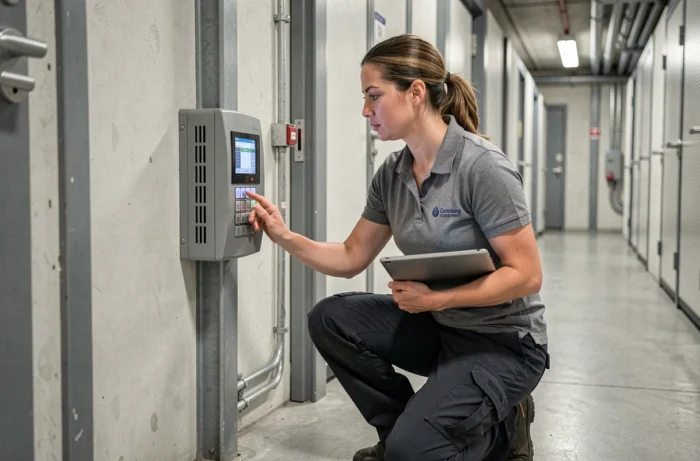
Access control by zones is a concrete lever. Rather than a single badge granting access to the entire site, segmenting permissions by storage area allows for tracking movements and limiting exposure of high-value goods.
Traceability and Deterrence in Daily Operations
Surveillance plays a different role here than nighttime anti-intrusion protection. During the day, visible cameras in order preparation and shipping areas act as a documented deterrent. Their effectiveness relies on two conditions: that recordings are indeed retained and accessible, and that teams know the system is active.
Coupling this system with real-time inventory management allows for quick detection of discrepancies. A weekly rotating inventory of high-value items reduces the time between a theft and its detection, complicating the repetition of such acts.
Lighting and Outdoor Layout: Beyond the Obvious
Peripheral lighting is included in all security guides, but its effectiveness depends on parameters that are rarely specified. Poorly directed lighting creates exploitable shadow areas. Overly bright lighting generates glare that makes cameras less effective at night.
- Prefer LED lighting with motion detection rather than permanent lighting, which ends up being ignored by the neighborhood and loses its alert effect
- Direct light sources towards access points (doors, docks, windows) rather than general circulation areas
- Remove tall vegetation close to fences and walls, which provides natural cover for intruders
The layout of the land around the warehouse falls under situation prevention, a concept used by law enforcement to reduce opportunities for criminal acts. Modifying the physical environment often costs less than an additional electronic system, and the two approaches mutually reinforce each other.
The protection of a warehouse relies on the interplay between physical devices, digital access management, and adaptation to activity fluctuations. No layer of security alone compensates for the weaknesses of others. Recent data on the increase in summer burglaries and attacks targeting connected systems confirm that the threat evolves faster than standard practices.