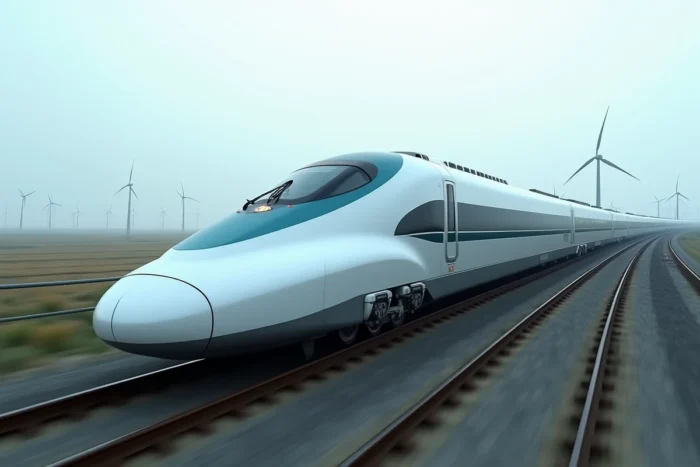
When you take a high-speed train in Europe, you zoom along at 300 or 320 km/h and find it fast. In Shanghai, passengers on the Maglev board for a daily journey where the train reaches 431 km/h in commercial service. China holds this record, and the gap with the rest of the world is significant.
Shanghai Maglev: what it means to travel at 431 km/h daily
The Shanghai Maglev connects Pudong International Airport to downtown. The train does not run on conventional tracks: it levitates above the track thanks to magnetic levitation, eliminating mechanical friction between the train and the infrastructure.
In practice, this translates to a journey of just a few minutes for a distance that a taxi covers in a good half-hour. The peak speed achieved in commercial operation, 431 km/h, makes it the fastest train in the world accessible to the general public.
This record is not a figure obtained during a test on a closed track. It is the actual speed displayed in the cabins, with passengers on board, on a regular service. To learn everything about the fastest train in the world, it is essential to distinguish this commercial performance from test records, where the conditions are very different.

Test records on rail: France and Japan in the race
The speed record in commercial service belongs to China, but the test records tell a different story. France has made its mark in the rail sector with the TGV, one of which reached 574.8 km/h during a test on the European high-speed East line in 2007. This performance remains the absolute speed record on conventional rail (wheel-rail).
Japan, for its part, is working on a Maglev technology different from that of the Shanghai Maglev. The Chūō Shinkansen project aims for a commercial speed of 500 km/h between Tokyo (Shinagawa) and Nagoya, then Osaka. Japanese tests have already exceeded this threshold on the Yamanashi test track.
Two distinct technical philosophies
The wheel-rail technology, that of the French TGV, the German ICE, or the classic Shinkansen, relies on physical contact between the wheel and the rail. It has been pushed to its limits during French tests, but friction imposes a physical ceiling that is difficult to overcome.
Magnetic levitation eliminates this contact. The train literally floats above the track. The Shanghai Maglev uses an electromagnetic suspension system (EMS), while the Japanese Maglev relies on an electrodynamic suspension system (EDS) with superconducting magnets. Opinions vary on which of these two approaches offers the best long-term potential.
- Wheel-rail (TGV, classic Shinkansen, ICE): mature technology, extensive global network, commercial speed capped around 350 km/h
- Maglev EMS (Shanghai): in operation for over twenty years, commercial speed of 431 km/h, but network limited to a single line
- Maglev EDS (Chūō Shinkansen, Japan): designed for 500 km/h in commercial service, not yet open to the public
Actual commercial speed: the ranking of countries in operation
Beyond the records, what matters to a traveler is the speed at which they are actually moving. China also dominates in this area. Its high-speed rail network is the largest in the world, with lines where trains commonly run at 350 km/h.
The Chinese high-speed network is the largest on the planet. Connections between Beijing, Shanghai, Guangzhou, or Wuhan are provided by trains that maintain some of the highest commercial speeds in the world on conventional rail.
Where France and Japan stand
The French TGV operates in commercial service at a maximum speed of around 320 km/h on the most recent lines. The Japanese Shinkansen reaches comparable levels. Both countries have been pioneers in high-speed rail, but China has surpassed its predecessors in speed and network volume.
Spain, Germany, and Italy also operate high-speed lines, with commercial speeds ranging from 250 to 300 km/h depending on the lines and operators.

Trains of the future: who could break the Chinese record
The Japanese Chūō Shinkansen is the most serious candidate to dethrone the Shanghai Maglev. Its projected commercial speed of 500 km/h would significantly exceed the current 431 km/h. However, the project has faced delays, particularly due to difficulties in tunnel construction in the Japanese Alps.
China is not remaining idle. Several next-generation Maglev prototypes are under development, with even more ambitious target speeds. The competition between China and Japan shapes the future of very high-speed rail transport.
- Japan (Chūō Shinkansen): goal of 500 km/h in commercial service, Tokyo-Nagoya-Osaka connection
- China: next-generation Maglev prototypes in testing phase, announced speeds exceeding 600 km/h
- Europe: no Maglev project, but SNCF is developing the TGV M, focused on energy efficiency and capacity rather than pure speed
The European approach diverges significantly. The TGV M, the next high-speed train from SNCF, does not aim for a new speed record. Its goal is to reduce energy consumption and increase seating capacity. France has chosen not to chase km/h anymore.
The record for the fastest train in commercial service belongs to China with the Shanghai Maglev and its 431 km/h. Japan could regain the lead if the Chūō Shinkansen enters service as planned. In the meantime, it is indeed on Chinese soil that the fastest travel occurs every day, with passengers on board.