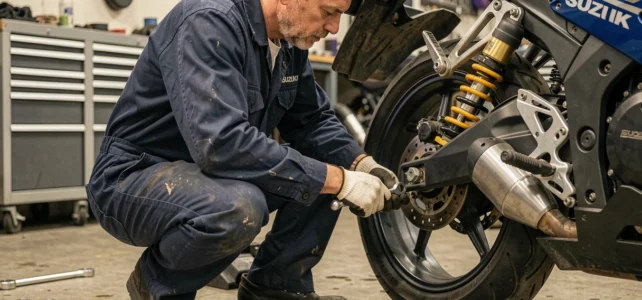
The suspension of a Suzuki GSX 600 R relies on a Showa BPF fork at the front and a rear shock absorber with a separate reservoir. Both components are fully adjustable, meaning that each parameter (preload, compression, rebound) can be tailored to the rider’s weight and the type of track. Modifying these settings without a method is akin to groping in the dark: the result will be random, sometimes worse than the factory setup.
Rear Ride Height and Geometry of the GSX 600 R
Discussions on forums almost always focus on compression and rebound clicks. One parameter often takes a back seat: the adjustment of the rear ride height. On recent models of the GSX-R600, this adjustment exists in addition to rebound and compression, and it directly modifies the geometry of the motorcycle.
Raising the rear ride height virtually shortens the wheelbase and makes the steering sharper. Lowering it produces the opposite effect: more stability in a straight line, less nervousness when entering a curve. This adjustment takes effect even before touching a single damping click.
For road use, the original position is an acceptable compromise. On the track, a rider seeking agility in tight corners will benefit from raising the ride height by one or two notches. The effect is felt from the first turns, much more noticeably than a half-turn of the compression knob. Those who wish to delve deeper into the subject can learn more on Automobile Référence, where the issue of geometry is detailed.

Setting the Sag Before Adjusting Suspension Clicks
Sag refers to the static compression of the suspension under the weight of the rider in riding position. It is the first measurement to take, and the only one that allows you to know if the stock spring suits your build.
Measuring the Sag on the GSX 600 R
The procedure requires a tape measure, a cable tie, and a second person. First, measure the total travel of the suspension without load (motorcycle on a stand, wheel off the ground). Then, the rider gets on in full gear, feet on the footpegs, and the measurement is taken again. The difference between the two values gives the sag.
If the sag obtained is too low (the motorcycle barely sinks), the preload is too high or the spring is too stiff for the rider’s build. Conversely, excessive sag indicates a spring that is too soft or insufficient preload.
When the Stock Spring is No Longer Enough
A light rider on a stock spring will always lack useful travel, regardless of the number of clicks adjusted. Manufacturers calibrate springs for an average build. Below or above this range, replacing the spring with a model of the appropriate rate becomes the only truly effective solution. Adjusting the preload does not compensate for too great a stiffness difference.
Compression and Rebound of the Showa BPF Fork
Once the sag is correctly set, adjustments to compression and rebound make complete sense. On the Showa BPF fork of the GSX-R600, compression is adjusted at the top of the left tube and rebound at the top of the right tube.
- Compression controls the speed at which the fork compresses when the front wheel encounters an obstacle or when weight shifts during braking. If too open, the fork dives sharply. If too closed, it transmits every imperfection of the surface to the handlebars.
- Rebound manages the speed at which the fork returns to its initial position. If rebound is too fast, it causes the front wheel to bounce and reduces grip. If too slow, the fork remains compressed and no longer absorbs subsequent irregularities.
- The recommended method is to start from the midpoint position (all clicks counted, then return to halfway), ride, and then adjust one or two clicks at a time while noting each change.
The temptation to tighten everything to “harden” the bike before a track outing is common. The result is almost always counterproductive: a suspension that is too stiff loses traction because the wheel lifts off on every bump instead of following the road profile.
Rear Shock: Adapting Rebound for Track Riding
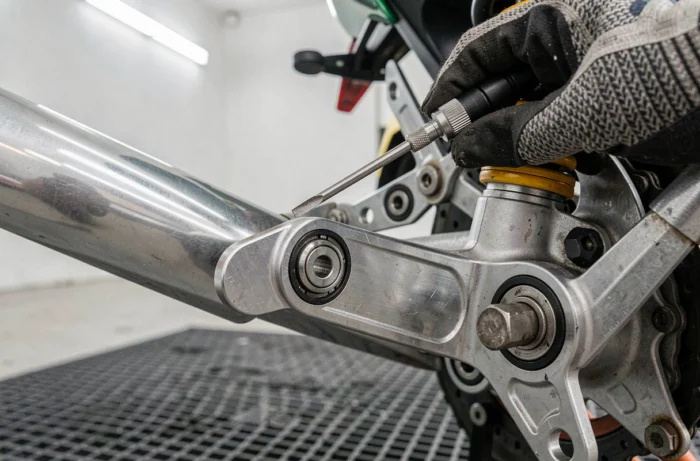
The rear shock of the GSX 600 R offers three distinct adjustments: spring preload, compression, and rebound. Rear rebound directly influences stability on corner exit, at the moment when the rider opens the throttle and weight shifts to the rear.
If rebound is too fast, it causes the rear wheel to bounce, resulting in a loss of traction during acceleration. If rebound is too slow, it prevents the shock from returning to position and “compresses” the suspension, reducing the available travel for the next turn.
On the track, the adjustment of rear compression deserves special attention during hard braking. When the rear unloads significantly, too soft a compression allows the motorcycle to stand up unpredictably. Closing the compression by a few clicks stabilizes the stance without sacrificing comfort on fast sections.
Adjustment Order and Validation Method on the GSX-R600
The sequence is as important as the adjustments themselves. Modifying several parameters at once makes it difficult to identify what improves or degrades the behavior.
- First, adjust the rear ride height to set the base geometry.
- Measure and adjust the sag front and rear to verify the suitability of the springs for the rider’s weight.
- Adjust compression (front then rear), one or two clicks per session, systematically noting the values.
- Finish with rebound, which fine-tunes the dynamic response without altering the static stance.
Each modification should be followed by a test ride before moving on to the next parameter. A setup notebook with the date, weather conditions, and exact values of each click helps avoid losing a configuration that worked.
Setting the suspension on a GSX 600 R is not mysterious, but it requires rigor. The geometry is set first, the sag validates the springs, and the compression and rebound clicks only come last. Skipping a step is like adjusting a detail while the overall framework remains unsuitable.