
A sliding gate that integrates a pedestrian gate within one of its panels addresses a concrete issue: allowing pedestrian passage without activating the motorization of the main gate. This type of installation is growing in residential areas, but its technical framework remains poorly understood. Safety standards, installation constraints, choice of structural material: the parameters that determine the success of the project go far beyond aesthetic considerations.
Standards NF EN 13241 and NF EN 12453: what they require for the integrated pedestrian gate
All new motorized installations fall under the NF EN 13241 standard (motorized gates) and the NF EN 12453 standard (safety of use and obstacle detection). These texts, consolidated around 2017-2018, remain in effect for installations installed today.
The presence of an integrated pedestrian gate does not exempt any obligation. The gate must include effort limitation and obstacle detection devices (photoelectric cells, sensitive edges) throughout the entire travel of the leaf, including the pedestrian gate. A manual release accessible in case of power failure is also required.
The choice of a sliding gate with integrated pedestrian gate therefore involves verifying that the manufacturer or installer guarantees compliance with these two standards. A non-compliant gate places the owner’s liability at risk in the event of an accident, especially if children or animals are nearby.
Electromagnetic compatibility: a parameter ignored by most installers
The motorization of a sliding gate generates electromagnetic signals. The European EMC directive, transposed into French law, requires that the motor and its electronics do not interfere with neighboring equipment: intercom, videophone, home automation network, connected video phone.
In return, these same devices must not interfere with the operation of the gate. Field feedback varies on this point: some users report false triggers or signal loss on their intercom after the installation of a motorization, without the cause always being identified.
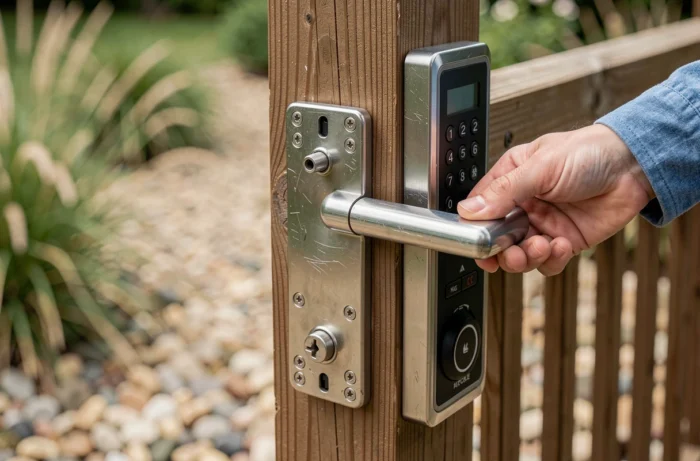
For a sliding gate with an integrated pedestrian gate, the issue is more acute. The pedestrian gate often has its own electric strike or its own electromagnetic locking system, which adds an additional component to the chain. Requesting an EMC test from the installer after installation, or at a minimum a verification of the simultaneous operation of all peripheral devices, remains the most reliable precaution.
Installation constraints and urban planning rules for the sliding gate
The sliding gate requires a lateral setback at least equal to the width of the opening. This length of rail on the ground (or guide in the case of a cantilever gate) determines the feasibility of the project. A sloped terrain, a fence wall that is too short, or a poorly placed drainage access point can make installation impossible without additional masonry work.
The Local Urban Plan (PLU) of the municipality also sets specific rules:
- The opening of the gate must occur inside the property, which is naturally the case for a sliding gate (unlike a swing gate that may encroach on the sidewalk)
- A setback from the public road may be required depending on the municipality, even for a sliding gate
- The maximum height of the fence is regulated, and the gate (including the pedestrian gate) must comply with it
Consulting the PLU before placing the order avoids costly modifications. Some projects require a prior declaration of works, especially when the fence faces a public road.
Aluminum, PVC, or composite: which material for a sliding gate with an integrated pedestrian gate
The choice of material influences the structural rigidity of the leaf, and this rigidity is a critical parameter when the gate integrates a pedestrian gate. The cut in the panel to create the pedestrian opening mechanically weakens the leaf. The material must compensate for this loss of rigidity.
Aluminum remains the reference material for this type of configuration. Its lightness limits the load on the motor and the rail, while its resistance to corrosion eliminates the need for regular maintenance. Aluminum profiles also allow for the integration of internal reinforcements at the cut of the pedestrian gate, without significantly increasing the overall weight.

PVC, more affordable in price, poses a rigidity problem on larger widths. Beyond four meters, a sliding gate in PVC with an integrated pedestrian gate may show deformations over time, especially under heat. Feedback on composite gates in this configuration remains too limited to accurately assess their durability over time.
Motorization and weight threshold
Each motor for a sliding gate is designed for a maximum leaf weight. The integrated pedestrian gate, with its strike, hinges, and reinforcement frame, adds several kilograms. An undersized motor wears out prematurely and triggers frequent safety stops.
Checking the technical data sheet of the motor and comparing the actual weight of the leaf (including the equipped pedestrian gate) to the threshold indicated by the manufacturer is a step that many owners overlook. Professional installers calculate this load, but in DIY installations, the risk of undersizing the motor is real.
Sliding gate with pedestrian gate: the limits to know before ordering
The integration of the pedestrian gate into the sliding leaf presents constraints that commercial catalogs rarely mention:
- The pedestrian gate cannot be placed anywhere on the leaf. Its position depends on the location of the rail, the receiving post, and the setback area. Poor positioning prevents the complete opening of the pedestrian gate when the gate is in the closed position
- The width of the pedestrian passage remains less than that of a standalone pedestrian gate. Passing with a stroller, wheelchair, or loaded bicycle can be difficult depending on the models
- The sealing at the junction between the pedestrian gate and the leaf is a recurring weak point. The seals wear out faster than elsewhere on the structure, generating vibrations and noise when the motorized gate passes
The sliding gate with integrated pedestrian gate is particularly suitable for properties where space does not allow for a separate pedestrian gate next to the gate. For properties with sufficient fence linearity, a standalone pedestrian gate offers superior passage width and durability. The configuration of the terrain, the available fence linearity, and the required passage width are the three criteria that truly guide this decision.