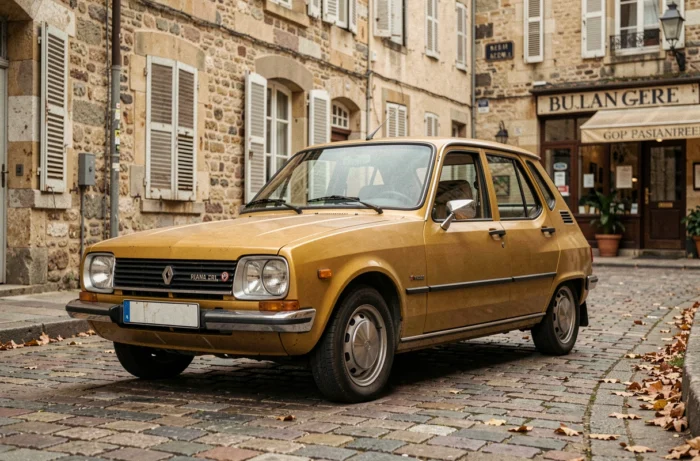
The Renault 5, known as the R5, and the Super 5 share a name, a manufacturer, and a familiar silhouette. They belong to two distinct generations of Renault city cars, separated by a decade of technical and stylistic changes. With the arrival of the R5 E-Tech electric, the question of their differences takes on additional significance, particularly in terms of everyday use in the city.
Low Emission Zones and Crit’Air: the Super 5 facing traffic restrictions
Low emission zones (ZFE) established in major French urban areas radically change the game for older thermal city cars. The Super 5, produced between 1984 and 1996, is classified as Crit’Air 5 or unclassified depending on its year of registration. Paris already bans certain Crit’Air classes, and broader restrictions will come into effect by 2027.
In practical terms, driving a Super 5 daily in a metropolis subject to a ZFE becomes a major constraint. The allowed time slots are reduced, fines apply, and reselling to an urban dweller loses all meaning. For those who want to know everything about the difference between the R5 and the Super 5, this regulatory point has become as crucial as the mechanical differences.
The R5 E-Tech electric, on the other hand, operates without any zone restrictions. Free access to city centers is a structural advantage that the Super 5, charming as it may be, can no longer offer in a French urban context.
Platform and powertrain: from thermal to native electric
The Super 5 was based on an evolution of the original R5 platform, with gasoline engines ranging from small modest displacements to the famous turbo block of the GT Turbo. The transmission remained simple, with a four or five-speed manual gearbox as standard, and the chassis retained solutions inherited from the 1970s (torsion bars, trailing arm rear axles).
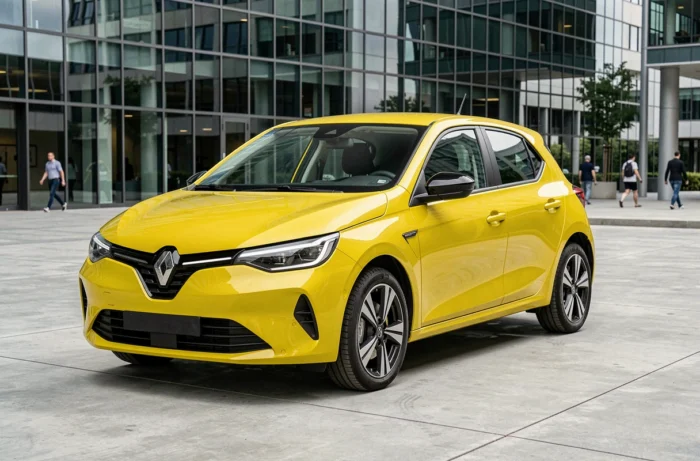
The R5 E-Tech is based on the AmpR Small platform, designed from the outset for electric vehicles. The battery is integrated into the floor, lowering the center of gravity and freeing up the cabin space. The electric motor delivers torque available from the start, without shifting gears.
- The Super 5 offered several gasoline engines and an atmospheric diesel, with power and consumption varying widely depending on the version.
- The R5 E-Tech operates on a lithium-ion battery and offers several capacity levels in kWh depending on the chosen trim.
- The charging system of the R5 E-Tech accepts fast charging in direct current, a concept that did not exist at the time of the Super 5.
This platform break explains why the R5 E-Tech is not just a nostalgic facelift. The lineage is aesthetic, not mechanical.
Design and interior: stylistic citation versus direct heritage
Visually, the Super 5 modernized the R5 without denying it. The lines became more taut, the windshield more sloped, and the rear lights horizontal. The interior gained space and finish compared to the first-generation R5, while remaining sober and functional.
The R5 E-Tech adopts graphic codes from the original R5 rather than the Super 5: the front end with its round headlights recalls the early series from the 1970s. The treatment is intentionally retro-futuristic, with recycled materials in the cabin and a dashboard centered around a digital screen.
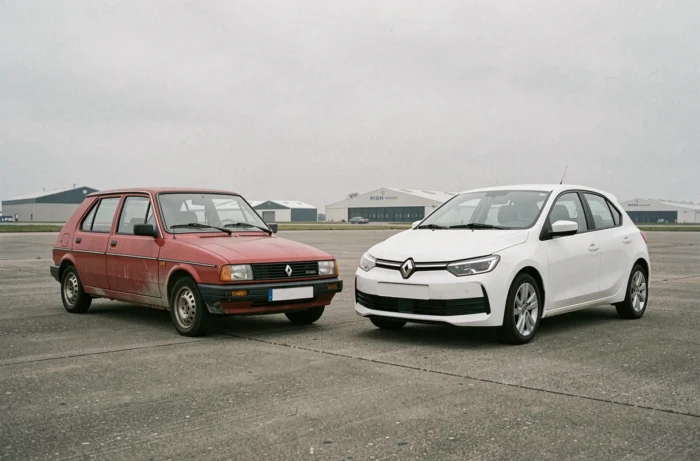
The Super 5 extended the R5, while the R5 E-Tech cites it. One was a logical industrial evolution, the other is a design exercise that draws from the collective imagination to dress a new technology.
Trims and features of the E-Tech range
The R5 E-Tech range comes in several trims (including Techno and Iconic Five levels) with comfort and connectivity features that bear no comparison to what the Super 5 offered: parking assistance, touchscreen, remote software updates. The Super 5, for its part, offered power steering and air conditioning as options at the high end, which already represented a luxury for a city car of its time.
Manufacturing and industrial anchoring of the R5 E-Tech
The Renault 5 E-Tech is produced within the ElectriCity hub in northern France, an industrial complex housing several factories dedicated to electric vehicles. More than 80% of its components come from European suppliers, according to Renault Group. This local anchoring contrasts with the production of the Super 5, which relied on a network of factories spread between Flins, Douai, and sites abroad.
This choice of location is not trivial for the buyer. It determines eligibility for the French ecological bonus, which excludes vehicles whose production does not meet certain criteria for European content. The Super 5, as an old used vehicle, obviously does not fall under any purchase aid scheme.
R5 E-Tech or Super 5: two uses, two eras
Comparing these two cars amounts to measuring the gap between two visions of the popular city car. The Super 5 remains a collector’s item or a passion project, with accessible mechanical maintenance and an active community of owners. Its value is emotional and heritage-related.
The R5 E-Tech meets a contemporary specification: zero local emissions, access to ZFEs, home charging or rapid charging, and reduced fuel usage costs. The entry price of the electric range remains higher than that of a used thermal model, but public subsidies and the cost per kilometer change the long-term calculation.
The thermal Super 5 still offers complete freedom on country roads and national routes, where ZFEs do not exist. For strictly rural or suburban use, it retains a relevance that urban restrictions do not diminish. The choice depends less on nostalgia than on where one drives.